Ch. 3 - An Introduction to Organic Compounds:Nomenclature, Physical Properties, and Structure
Bruice - Organic Chemistry 8th Edition
Bruice8th EditionOrganic ChemistryISBN: 9780135213711Not the one you use?Change textbook
Chapter 4, Problem 54b

What is the energy difference between the two chair conformers of cis-1,4-dimethylcyclohexane?

Verified step by step guidance
1
Identify the two chair conformations of cis-1,4-dimethylcyclohexane. In the cis configuration, both methyl groups are on the same side of the cyclohexane ring. This means one methyl group will be axial and the other equatorial in one chair conformation, and the positions will switch in the other chair conformation.
Determine the steric strain associated with each conformation. The axial methyl group in each conformation will experience 1,3-diaxial interactions, which contribute to steric strain. Use the standard energy value for a methyl group in the axial position (approximately 7.6 kJ/mol or 1.8 kcal/mol per methyl group).
Calculate the total steric strain for each chair conformation. In one conformation, the axial methyl group contributes to the steric strain, while the equatorial methyl group does not. In the other conformation, the positions of the methyl groups are reversed, so the steric strain will be the same.
Compare the steric strain of the two conformations. Since the steric strain is the same in both conformations (one axial and one equatorial methyl group in each), the energy difference between the two chair conformers is zero.
Conclude that for cis-1,4-dimethylcyclohexane, the two chair conformers are equally stable because the steric strain is identical in both conformations.

Verified video answer for a similar problem:

This video solution was recommended by our tutors as helpful for the problem above.
Video duration:
6m
Was this helpful?

Key Concepts

Here are the essential concepts you must grasp in order to answer the question correctly.

Chair Conformation

Chair conformation is the most stable arrangement of cyclohexane rings, minimizing steric strain and torsional strain. In this conformation, carbon atoms adopt a staggered arrangement, allowing for optimal bond angles and reducing interactions between substituents. Understanding chair conformations is crucial for analyzing the stability of substituted cyclohexanes, such as cis-1,4-dimethylcyclohexane.
Recommended video:
Guided course
03:29
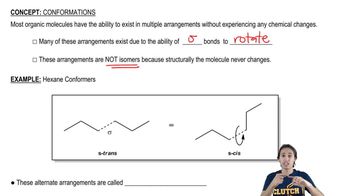
Understanding what a conformer is.

Steric Strain

Steric strain arises when atoms are forced closer together than their atomic radii allow, leading to increased energy and instability. In the context of cyclohexane derivatives, substituents can experience steric interactions depending on their positions (axial or equatorial) in the chair conformation. Evaluating steric strain is essential for determining the energy difference between conformers.
Recommended video:
Guided course
02:00
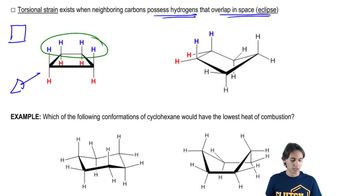
What is torsional strain?

Equatorial vs. Axial Position

In chair conformations, substituents can occupy either equatorial or axial positions. Equatorial positions are generally more stable as they minimize steric interactions with other axial substituents on the same side of the ring. For cis-1,4-dimethylcyclohexane, analyzing the positions of the methyl groups helps predict the more stable conformer and calculate the energy difference between the two chair forms.
Recommended video:
Guided course
04:02
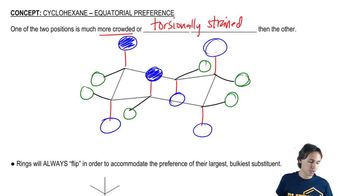
Equatorial Preference