Ch. 3 - An Introduction to Organic Compounds:Nomenclature, Physical Properties, and Structure
Bruice - Organic Chemistry 8th Edition
Bruice8th EditionOrganic ChemistryISBN: 9780135213711Not the one you use?Change textbook
Chapter 4, Problem 57(7,8)

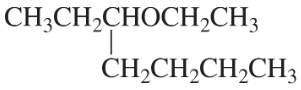
a. What is each compound’s systematic name?
b. Draw a skeletal structure for each condensed structure given and draw a condensed structure for each skeletal structure.
7.
8. CH3OCH2CH2CH2OCH3

Verified step by step guidance
1
Step 1: Analyze the given condensed structure (CH3CH2CHOCH2CH3 with CH2CH2CH2CH3 as a branch) and identify the longest continuous carbon chain. This chain will determine the base name of the compound.
Step 2: Identify and name any substituents or branches attached to the main chain. In this case, there is an ether functional group (-O-) and an alkyl branch.
Step 3: Assign locants (numbers) to the carbon atoms in the main chain to indicate the positions of substituents. Start numbering from the end closest to the substituent or functional group to minimize the locant numbers.
Step 4: Combine the names of the substituents, locants, and the base name of the compound to form the systematic name. Ensure the ether group is named appropriately (e.g., as an alkoxy group).
Step 5: Draw the skeletal structure by representing the main chain as a zigzag line and showing the substituents and functional groups as branches. Then, convert the skeletal structure back into a condensed structure by writing out the molecular formula in a compact form.

Verified video answer for a similar problem:

This video solution was recommended by our tutors as helpful for the problem above.
Video duration:
10m
Was this helpful?

Key Concepts

Here are the essential concepts you must grasp in order to answer the question correctly.

Systematic Naming of Organic Compounds

Systematic naming, or IUPAC nomenclature, is a standardized method for naming organic compounds based on their structure. It involves identifying the longest carbon chain, naming substituents, and applying appropriate prefixes and suffixes to indicate functional groups. For example, in the compound CH3OCH2CH2CH2OCH3, the systematic name would reflect the presence of ether functional groups and the carbon chain length.
Recommended video:
Guided course
03:59
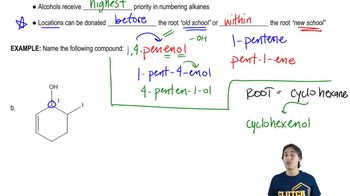
Name the following compound

Skeletal Structures

Skeletal structures are simplified representations of organic molecules that depict the carbon backbone and functional groups without showing all hydrogen atoms. Each vertex represents a carbon atom, and hydrogen atoms are implied. This method allows chemists to visualize complex molecules more easily and is essential for drawing and interpreting organic compounds efficiently.
Recommended video:
Guided course
04:03
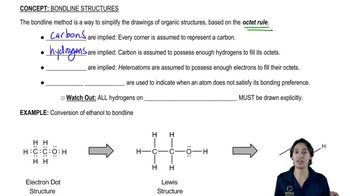
How bondline is different from Lewis Structures.

Condensed Structures

Condensed structures provide a way to represent organic molecules in a more compact form, showing the connectivity of atoms without the full structural details. In condensed formulas, groups of atoms are often grouped together, such as CH3-CH2- for ethyl groups. Understanding how to convert between condensed and skeletal structures is crucial for accurately interpreting and drawing organic compounds.
Recommended video:
Guided course
06:06
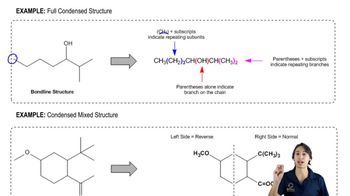
How to interpret condensed structures.