Ch. 28 - Pericyclic Reactions
Bruice - Organic Chemistry 8th Edition
Bruice8th EditionOrganic ChemistryISBN: 9780135213711Not the one you use?Change textbook
Chapter 25, Problem 37c

Draw the product of each of the following sigmatropic rearrangements:
c. Chemical structure illustrating a [5,5] sigmatropic rearrangement with a phenyl group and a diene.

Verified step by step guidance
1
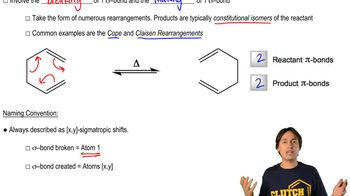
Identify the type of sigmatropic rearrangement involved. Sigmatropic rearrangements are pericyclic reactions where a sigma bond migrates across a conjugated π-system. Common examples include [1,3]-shifts, [1,5]-shifts, and the Claisen or Cope rearrangements.
Determine the numbering of the atoms involved in the rearrangement. For example, in a [3,3]-sigmatropic rearrangement, the sigma bond migrates between two sets of three atoms, maintaining the connectivity of the π-system.
Draw the starting structure and locate the sigma bond that will break and the new sigma bond that will form. Use curved arrows to show the movement of electrons during the rearrangement.
Apply the Woodward-Hoffmann rules to ensure that the rearrangement is thermally allowed. These rules are based on the conservation of orbital symmetry and help confirm whether the reaction proceeds under thermal or photochemical conditions.
Draw the product of the rearrangement, ensuring that the new sigma bond is correctly formed and the π-system is properly reconnected. Verify that the product structure is consistent with the reaction mechanism and the type of sigmatropic shift identified.

Verified video answer for a similar problem:

This video solution was recommended by our tutors as helpful for the problem above.
Was this helpful?

Key Concepts

Here are the essential concepts you must grasp in order to answer the question correctly.

Sigmatropic Rearrangements

Sigmatropic rearrangements are a class of pericyclic reactions where a sigma bond and a pi bond undergo a concerted rearrangement. These reactions typically involve the migration of a substituent across a double bond, resulting in a structural change of the molecule. Understanding the mechanism and the types of sigmatropic rearrangements, such as [1,3] or [3,3] shifts, is crucial for predicting the products formed.
Recommended video:
Guided course
03:20
Nomenclature of Sigmatropic Shifts

Conservation of Orbital Symmetry

Conservation of orbital symmetry is a principle that states that the symmetry of molecular orbitals must be preserved during a reaction. In sigmatropic rearrangements, this principle helps determine whether a reaction is allowed or forbidden based on the symmetry properties of the involved orbitals. Recognizing the symmetry of the reactants and products is essential for predicting the feasibility of the rearrangement.
Recommended video:
Guided course
00:25
Determining Chirality with Plane of Symmetry

Regioselectivity

Regioselectivity refers to the preference of a chemical reaction to yield one structural isomer over others when multiple products are possible. In sigmatropic rearrangements, regioselectivity can be influenced by factors such as sterics and electronic effects, which dictate the most stable product. Understanding regioselectivity is important for accurately predicting the outcome of the rearrangement and the structure of the final product.
Recommended video:
Guided course
05:09
Heck Reaction