Ch. 28 - Pericyclic Reactions
Bruice - Organic Chemistry 8th Edition
Bruice8th EditionOrganic ChemistryISBN: 9780135213711Not the one you use?Change textbook
Chapter 25, Problem 8a(2)

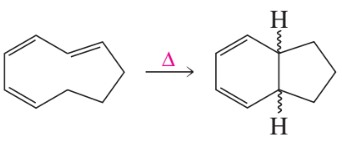
a. Identify the mode of ring closure for each of the following electrocyclic reactions
2. Chemical structures illustrating a reaction with indicated hydrogens, questioning their cis or trans configuration.

Verified step by step guidance
1
Analyze the given electrocyclic reaction and determine whether it involves a 4n or 4n+2 π-electron system. This is based on the number of π-electrons in the conjugated system undergoing the reaction.
Recall the Woodward-Hoffmann rules for electrocyclic reactions: (1) For a 4n π-electron system, the reaction proceeds via a conrotatory mode under thermal conditions and a disrotatory mode under photochemical conditions. (2) For a 4n+2 π-electron system, the reaction proceeds via a disrotatory mode under thermal conditions and a conrotatory mode under photochemical conditions.
Identify whether the reaction is occurring under thermal or photochemical conditions. This will determine which mode of ring closure (conrotatory or disrotatory) is favored.
Determine the stereochemical outcome of the reaction based on the mode of ring closure. In a conrotatory mode, the terminal substituents rotate in the same direction, while in a disrotatory mode, they rotate in opposite directions.
Apply the above rules to each specific reaction provided in the problem, ensuring to account for the number of π-electrons and the reaction conditions to identify the correct mode of ring closure.

Verified video answer for a similar problem:

This video solution was recommended by our tutors as helpful for the problem above.
Video duration:
9m
Was this helpful?

Key Concepts

Here are the essential concepts you must grasp in order to answer the question correctly.

Electrocyclic Reactions

Electrocyclic reactions are a type of pericyclic reaction where a conjugated system undergoes a concerted transformation to form a cyclic compound. These reactions typically involve the breaking and forming of sigma bonds in a cyclic manner, often influenced by thermal or photochemical conditions. Understanding the nature of these reactions is crucial for predicting the products formed during ring closure.
Recommended video:
Guided course
08:11
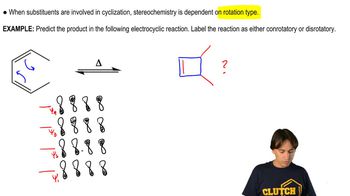
Predicting Electrocyclic Products

Conjugation and Aromaticity

Conjugation refers to the overlap of p-orbitals across adjacent double bonds, allowing for electron delocalization. This delocalization stabilizes the molecule and is a key factor in determining the reactivity of compounds in electrocyclic reactions. Aromaticity, a special case of conjugation, involves cyclic, planar structures with a specific number of pi electrons, influencing the mode of ring closure in these reactions.
Recommended video:
Guided course
03:27
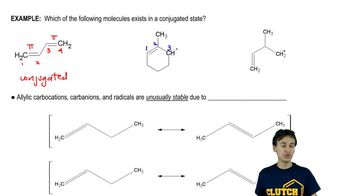
Conjugated states

Woodward-Hoffmann Rules

The Woodward-Hoffmann rules provide a framework for predicting the stereochemistry and outcome of pericyclic reactions, including electrocyclic reactions. These rules are based on the conservation of orbital symmetry and dictate whether a reaction will proceed under thermal or photochemical conditions. Understanding these rules is essential for determining the mode of ring closure in electrocyclic reactions.
Recommended video:
1:18
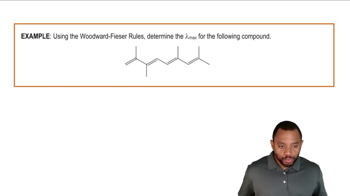
Woodward-Fieser Rules Example 1