Ch. 22 - Catalysis in Organic Reactions and in Enzymatic Reactions
Bruice - Organic Chemistry 8th Edition
Bruice8th EditionOrganic ChemistryISBN: 9780135213711Not the one you use?Change textbook
Chapter 23, Problem 21a

Draw the pH–activity profile for an enzyme that has one catalytic group at the active site:
a. the catalytic group is a general-acid catalyst with a pKa = 5.6.

Verified step by step guidance
1
Understand the concept of a pH–activity profile: This graph shows how the activity of an enzyme changes with pH. The activity is influenced by the ionization state of the catalytic group at the active site, which depends on its pKa value.
Identify the catalytic group as a general-acid catalyst: A general-acid catalyst donates a proton during the reaction. Its activity is highest when it is protonated, which occurs at pH values below its pKa.
Determine the ionization state of the catalytic group: At pH values below the pKa (5.6), the catalytic group will be mostly protonated and active. At pH values above the pKa, the group will be mostly deprotonated and less active.
Sketch the pH–activity profile: The enzyme activity will be high at low pH, decrease as the pH approaches the pKa (5.6), and drop significantly at higher pH values. The profile will resemble a bell-shaped curve centered around the pKa value.
Label the graph: On the x-axis, plot the pH values, and on the y-axis, plot the enzyme activity. Mark the pKa (5.6) on the graph as the point where the activity begins to decline significantly due to deprotonation of the catalytic group.

Verified video answer for a similar problem:

This video solution was recommended by our tutors as helpful for the problem above.
Was this helpful?

Key Concepts

Here are the essential concepts you must grasp in order to answer the question correctly.

pH-Activity Profile

The pH-activity profile of an enzyme illustrates how the enzyme's activity varies with changes in pH. It typically shows a bell-shaped curve, where enzyme activity is optimal at a specific pH and decreases at more acidic or basic conditions. Understanding this profile is crucial for determining the optimal conditions for enzyme function and can indicate the ionization state of active site residues.
Recommended video:
4:47
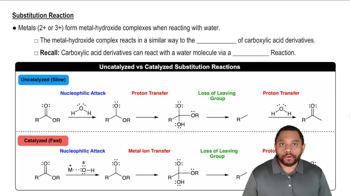
Metal Ion Catalysis: Water Activation Concept 2

General-Acid Catalysis

General-acid catalysis involves the donation of a proton (H+) from a catalytic group to a substrate, facilitating a chemical reaction. This process is dependent on the pKa of the catalytic group, which determines its protonation state at a given pH. In this case, with a pKa of 5.6, the catalytic group will be protonated at lower pH values, enhancing its ability to donate protons and thus influence the enzyme's activity.
Recommended video:
2:50
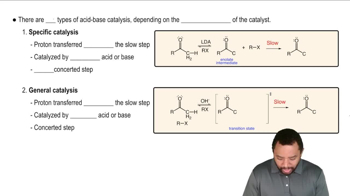
Acid-Base Catalysis Concept 3

pKa and Ionization

The pKa value of a functional group indicates the pH at which half of the molecules of that group are protonated and half are deprotonated. For the catalytic group with a pKa of 5.6, at pH values below this, the group is predominantly protonated, while above this pH, it becomes deprotonated. This transition is critical for understanding how changes in pH affect the enzyme's catalytic efficiency and overall activity.
Recommended video:
Guided course
07:45
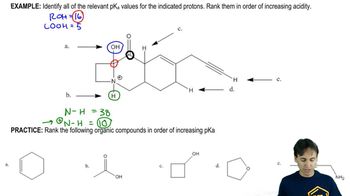
Identifying pKa values