Ch. 21 - Amino Acids, Peptides, and Proteins
Bruice - Organic Chemistry 8th Edition
Bruice8th EditionOrganic ChemistryISBN: 9780135213711Not the one you use?Change textbook
Chapter 22, Problem 8b

Draw the predominant form for glutamate in a solution with the following
pH: b. 3

Verified step by step guidance
1
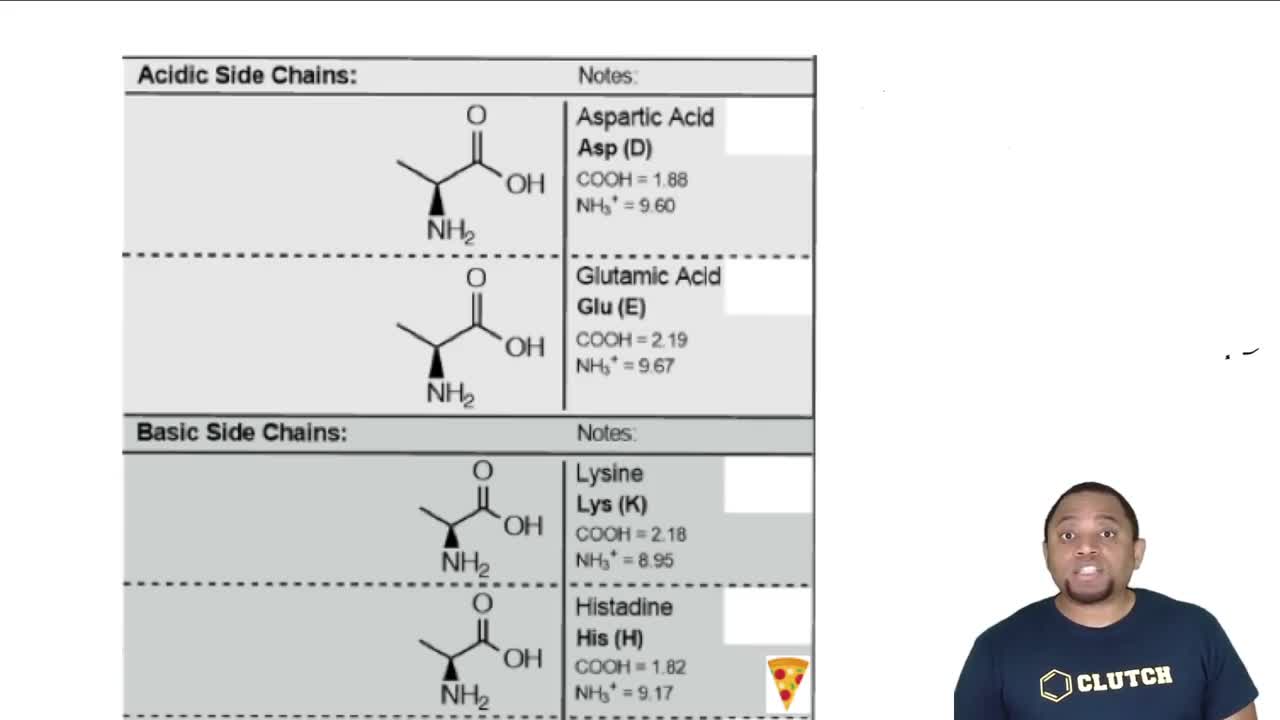
Determine the pKa values of the functional groups in glutamate. Glutamate has three ionizable groups: the α-carboxyl group (pKa ≈ 2.1), the α-amino group (pKa ≈ 9.5), and the side-chain carboxyl group (pKa ≈ 4.1).
Compare the pH of the solution (pH = 3) to the pKa of each functional group to determine their protonation states. If pH < pKa, the group will be protonated; if pH > pKa, the group will be deprotonated.
Analyze the α-carboxyl group (pKa ≈ 2.1): Since pH (3) > pKa (2.1), the α-carboxyl group will be deprotonated, forming a carboxylate ion (\( \text{COO}^- \)).
Analyze the side-chain carboxyl group (pKa ≈ 4.1): Since pH (3) < pKa (4.1), the side-chain carboxyl group will remain protonated as \( \text{COOH} \).
Analyze the α-amino group (pKa ≈ 9.5): Since pH (3) < pKa (9.5), the α-amino group will remain protonated as \( \text{NH}_3^+ \). Combine these observations to draw the predominant form of glutamate at pH 3.

Verified video answer for a similar problem:

This video solution was recommended by our tutors as helpful for the problem above.
Video duration:
5m
Was this helpful?

Key Concepts

Here are the essential concepts you must grasp in order to answer the question correctly.

Amino Acid Structure

Amino acids, the building blocks of proteins, consist of a central carbon atom bonded to an amino group, a carboxyl group, a hydrogen atom, and a variable R group. Glutamate, specifically, has a side chain that contains a carboxyl group, making it an acidic amino acid. Understanding the structure of glutamate is essential for predicting its behavior in different pH environments.
Recommended video:
Guided course
11:14
Charged Amino Acids

pH and Protonation States

pH is a measure of the acidity or basicity of a solution, influencing the protonation state of molecules. At low pH (like 3), amino acids can exist in their protonated forms, where the carboxyl group is likely to be protonated (–COOH) and the amino group remains protonated (–NH3+). This affects the overall charge and predominant form of glutamate in solution.
Recommended video:
Guided course
03:08
Ground vs. Excited States

Zwitterions

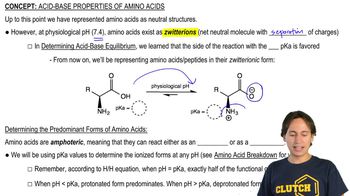
Zwitterions are molecules that have both positive and negative charges but are overall neutral. In the context of amino acids, at physiological pH, they often exist as zwitterions. However, at a low pH like 3, glutamate will predominantly exist in a protonated form, which is crucial for understanding its behavior in biochemical processes and interactions.
Recommended video:
Guided course
04:41
Why Amino Acids Exist as Zwitterions