
Ch. 21 - Amino Acids, Peptides, and Proteins
Bruice - Organic Chemistry 8th Edition
Bruice8th EditionOrganic ChemistryISBN: 9780135213711Not the one you use?Change textbook
Chapter 22, Problem 54c

Draw the form of aspartate that predominates at the following pH values: c. pH=6.0

Verified step by step guidance
1
Determine the pKa values of the functional groups in aspartate. Aspartate has three ionizable groups: the α-carboxyl group (pKa ≈ 2.1), the α-amino group (pKa ≈ 9.8), and the side-chain carboxyl group (pKa ≈ 3.9). These pKa values will help us understand the protonation state of each group at pH 6.0.
Compare the pH (6.0) to the pKa of each functional group to determine its protonation state. If the pH is lower than the pKa, the group will be protonated. If the pH is higher than the pKa, the group will be deprotonated.
Analyze the α-carboxyl group (pKa ≈ 2.1). Since pH 6.0 is much higher than 2.1, the α-carboxyl group will be deprotonated, existing as COO⁻.
Analyze the side-chain carboxyl group (pKa ≈ 3.9). Since pH 6.0 is higher than 3.9, the side-chain carboxyl group will also be deprotonated, existing as COO⁻.
Analyze the α-amino group (pKa ≈ 9.8). Since pH 6.0 is lower than 9.8, the α-amino group will remain protonated, existing as NH₃⁺. Combine these observations to draw the predominant form of aspartate at pH 6.0, which will have a net charge based on the protonation states of the functional groups.

Verified video answer for a similar problem:

This video solution was recommended by our tutors as helpful for the problem above.
Video duration:
5m
Was this helpful?

Key Concepts

Here are the essential concepts you must grasp in order to answer the question correctly.

Amino Acids and Their Ionization

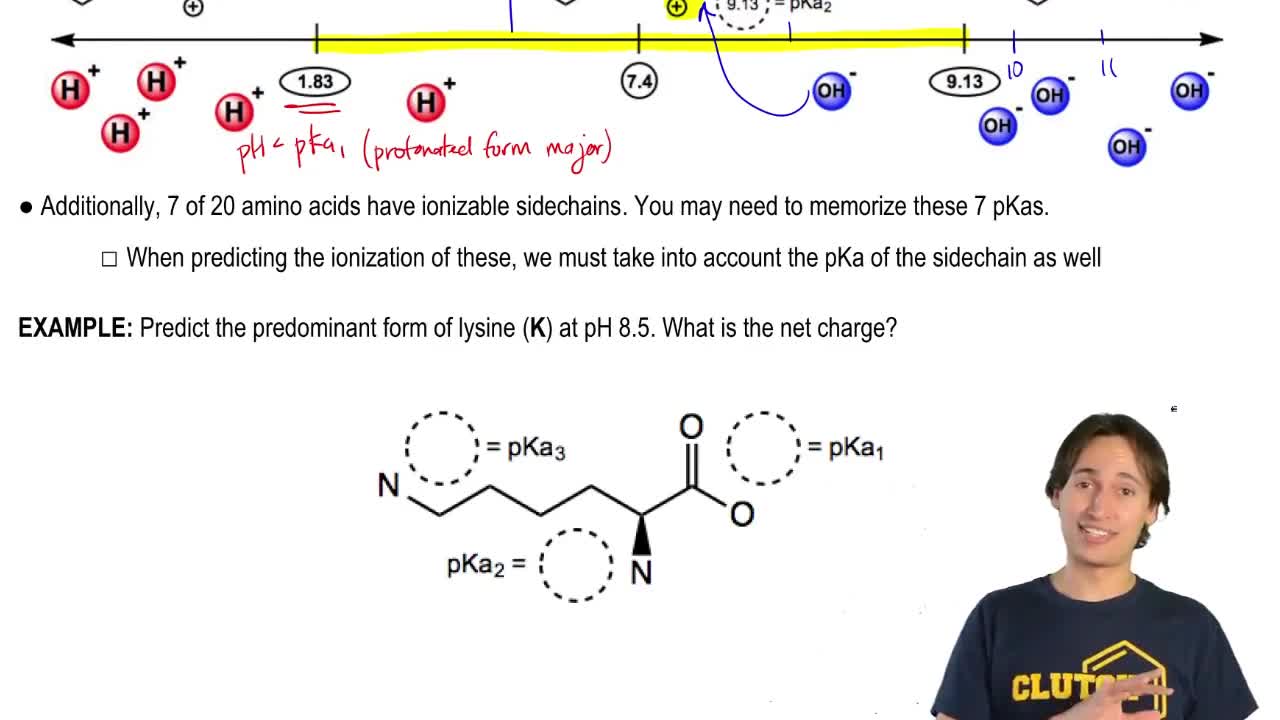
Amino acids, like aspartate, contain both an amino group and a carboxyl group, which can ionize depending on the pH of the solution. At different pH levels, the protonation and deprotonation of these groups affect the overall charge of the amino acid, influencing its predominant form in solution.
Recommended video:
Guided course
04:10
The 7 Ionizable Amino Acids

pKa Values

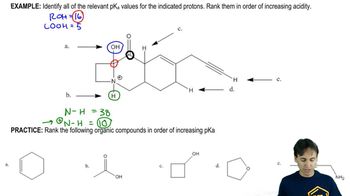
The pKa value is the pH at which half of the species is deprotonated. For aspartate, the pKa values of its carboxyl groups are crucial for determining its charge at a given pH. At pH 6.0, understanding the pKa values helps predict whether the carboxyl groups are protonated or deprotonated, thus influencing the molecule's overall charge.
Recommended video:
Guided course
07:45
Identifying pKa values

Zwitterions

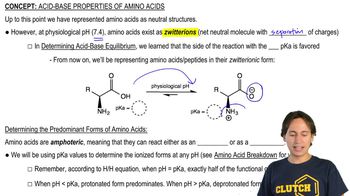
A zwitterion is a molecule that has both positive and negative charges but is overall neutral. At physiological pH (around 7.4), amino acids often exist as zwitterions. Understanding this concept is essential for predicting the predominant form of aspartate at pH 6.0, where it may still exhibit zwitterionic characteristics.
Recommended video:
Guided course
04:41
Why Amino Acids Exist as Zwitterions