
Ch. 20 - The Organic Chemistry of Carbohydrates
Bruice - Organic Chemistry 8th Edition
Bruice8th EditionOrganic ChemistryISBN: 9780135213711Not the one you use?Change textbook
Chapter 21, Problem 66

The specific rotation of α-D-galactose is 150.7 and that of β-D-galactose is 52.8. When an aqueous mixture that was initially 70% α-D-galactose and 30% β-D-galactose reaches equilibrium, the specific rotation is 80.2. What is the percentage of α-D-galactose and β-D galactose at equilibrium?

Verified step by step guidance
1
Step 1: Understand the concept of specific rotation and equilibrium. Specific rotation ([α]) is a physical property of chiral compounds that measures the degree to which they rotate plane-polarized light. At equilibrium, the specific rotation of a mixture is the weighted average of the specific rotations of its components, based on their respective proportions.
Step 2: Write the equation for the specific rotation of the mixture at equilibrium. The equation is: αeq = (x * αα) + ((1 - x) * αβ), where αeq is the specific rotation at equilibrium, αα is the specific rotation of α-d-galactose, αβ is the specific rotation of β-d-galactose, and x is the fraction of α-d-galactose at equilibrium.
Step 3: Substitute the known values into the equation. Use αeq = 80.2, αα = 150.7, and αβ = 52.8. The equation becomes: 80.2 = (x * 150.7) + ((1 - x) * 52.8).
Step 4: Solve for x, the fraction of α-d-galactose at equilibrium. Rearrange the equation to isolate x and solve algebraically. This will give you the proportion of α-d-galactose at equilibrium.
Step 5: Calculate the percentage of α-d-galactose and β-d-galactose at equilibrium. Multiply the fraction of α-d-galactose (x) by 100 to get the percentage of α-d-galactose. Subtract this percentage from 100 to find the percentage of β-d-galactose.

Verified video answer for a similar problem:

This video solution was recommended by our tutors as helpful for the problem above.
Video duration:
7m
Was this helpful?

Key Concepts

Here are the essential concepts you must grasp in order to answer the question correctly.

Specific Rotation

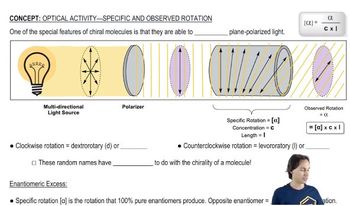
Specific rotation is a property of chiral compounds that quantifies the degree to which they rotate plane-polarized light. It is defined as the observed rotation of light at a specific wavelength and temperature, divided by the concentration of the solution and the path length of the light. This property is crucial for distinguishing between different stereoisomers, such as alpha and beta forms of sugars.
Recommended video:
Guided course
05:43
Specific rotation vs. observed rotation.

Equilibrium in Chemical Reactions

Equilibrium in chemical reactions refers to the state where the rates of the forward and reverse reactions are equal, resulting in constant concentrations of reactants and products over time. In the context of this question, it implies that the mixture of a-d-galactose and b-d-galactose will reach a stable ratio where their specific rotations contribute to the overall specific rotation of the solution.
Recommended video:
3:11
Chemical Reactions of Phosphate Anhydrides Concept 1

Weighted Average Calculation

Weighted average calculation is a method used to find the average of a set of values, where each value contributes differently based on its proportion. In this scenario, the specific rotations of a-d-galactose and b-d-galactose must be combined according to their respective percentages in the mixture to determine the overall specific rotation at equilibrium. This concept is essential for solving the problem presented.
Recommended video:
Guided course
04:37
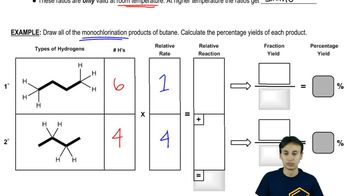
Draw all of the monochlorination products and calculate percentage yields.
Related Practice
Textbook Question

An unknown disaccharide gives a positive Tollens' test. A glycosidase hydrolyzes it to D-galactose and D-mannose. When the disaccharide is treated with methyl iodide and Ag2O and then hydrolyzed with dilute HCl, the products are 2,3,4,6-tetra-O-methylgalactose and 2,3,4-tri-O-methylmannose. Propose a structure for the disaccharide.

1
views
Textbook Question

Predict whether D-altrose exists preferentially as a pyranose or a furanose. (Hint: In the most stable arrangement for a five-membered ring, all the adjacent substituents are trans.)

Textbook Question

Draw each of the following:

a. β-D-talopyranose

b. α-D-idopyranose  

Textbook Question

Draw the mechanism for the elimination step in the Wohl degredation.

1
views
Textbook Question

A hexose is obtained when the residue of a shrub Sterculia setigeria undergoes acid-catalyzed hydrolysis. Identify the hexose from the following experimental information: it undergoes mutarotation; it does not react with Br2; and D-galactonic acid and D-talonic acid are formed when it reacts with Tollens’ reagent.

1
views
Textbook Question

Calculate the percentages of α\(\alpha\)-D-glucose and β\(\beta\)-D-glucose present at equilibrium from the specific rotations of α\(\alpha\)-D-glucose, β\(\beta\)-D-glucose, and the equilibrium mixture. Compare your values with those given in Section 20.10. (Hint: The specific rotation of the mixture equals the specific rotation of α\(\alpha\)-D-glucose times the fraction of glucose present in the a-form plus the specific rotation of β\(\beta\)-D-glucose times the fraction of glucose present in the β\(\beta\) -form.)

4
views