Ch. 20 - The Organic Chemistry of Carbohydrates
Bruice - Organic Chemistry 8th Edition
Bruice8th EditionOrganic ChemistryISBN: 9780135213711Not the one you use?Change textbook
Chapter 21, Problem 61

How many aldaric acids are obtained from the 16 aldohexoses?

Verified step by step guidance
1
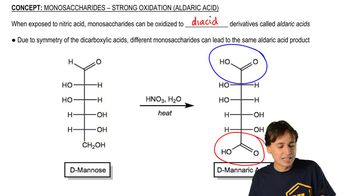
Understand the concept of aldaric acids: Aldaric acids are dicarboxylic acids formed by the oxidation of both the aldehyde group (C-1) and the primary alcohol group (C-6) of an aldose sugar. For aldohexoses, this means oxidizing both ends of the six-carbon sugar molecule.
Recognize the structural diversity of aldohexoses: There are 16 aldohexoses, which include 8 D-isomers and 8 L-isomers. These isomers differ in the stereochemistry of their chiral centers (C-2, C-3, C-4, and C-5).
Determine the effect of oxidation on stereochemistry: Oxidation of the aldehyde and primary alcohol groups does not affect the stereochemistry of the chiral centers (C-2, C-3, C-4, and C-5). Therefore, the stereochemical configuration of the original aldohexose is preserved in the resulting aldaric acid.
Account for potential meso compounds: Some aldaric acids may be meso compounds, which are achiral despite having chiral centers. Meso compounds result when the molecule has an internal plane of symmetry. For aldaric acids, this occurs when the stereochemistry of the chiral centers is symmetric about the central carbon (C-3).
Count the unique aldaric acids: Analyze the stereochemical configurations of the 16 aldohexoses to determine how many unique aldaric acids are formed, considering both enantiomers and any meso compounds. This involves identifying pairs of enantiomers and any meso compounds that reduce the total count of unique aldaric acids.

Verified video answer for a similar problem:

This video solution was recommended by our tutors as helpful for the problem above.
Video duration:
7m
Was this helpful?

Key Concepts

Here are the essential concepts you must grasp in order to answer the question correctly.

Aldoses and Aldohexoses

Aldoses are a type of monosaccharide that contain an aldehyde group. Aldohexoses specifically refer to six-carbon aldoses, which include sugars like glucose and galactose. Understanding the structure and properties of these sugars is essential for determining the types of aldaric acids that can be derived from them.
Recommended video:
Guided course
02:29
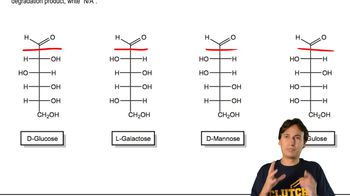
Which aldohexoses produce the same Wohl Degradation product

Aldaric Acids

Aldaric acids are dicarboxylic acids formed by the oxidation of both the aldehyde and the primary alcohol groups in aldoses. For each aldohexose, the oxidation leads to a unique aldaric acid, which retains the carbon skeleton of the original sugar. This concept is crucial for calculating the total number of distinct aldaric acids from the given aldohexoses.
Recommended video:
Guided course
03:10
Monosaccharides - Strong Oxidation (Aldaric Acid)

Isomerism in Sugars

Isomerism refers to the existence of compounds with the same molecular formula but different structural arrangements. In the case of aldohexoses, there are multiple isomers due to variations in the arrangement of hydroxyl groups and the configuration around the chiral centers. Recognizing these isomers is important for understanding how many unique aldaric acids can be produced from the 16 aldohexoses.
Recommended video:
Guided course
08:42
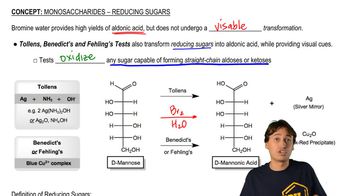
Reducing Sugars
Related Practice