Ch. 20 - The Organic Chemistry of Carbohydrates
Bruice - Organic Chemistry 8th Edition
Bruice8th EditionOrganic ChemistryISBN: 9780135213711Not the one you use?Change textbook
Chapter 21, Problem 5c

c. What sugar is the C-4 epimer of L-gulose?

Verified step by step guidance
1
Understand the concept of epimers: Epimers are stereoisomers that differ in configuration at only one specific carbon atom, while the rest of the molecule remains identical. In this case, we are looking for the sugar that differs from l-gulose at the C-4 position.
Review the structure of l-gulose: l-Gulose is a six-carbon aldose sugar (an aldohexose). Its stereochemistry at each chiral center (C-2, C-3, C-4, and C-5) determines its identity. Draw the Fischer projection of l-gulose to visualize its configuration.
Identify the C-4 position: In the Fischer projection of l-gulose, locate the hydroxyl group (-OH) attached to the fourth carbon atom (C-4). Note its orientation (either on the left or right side of the projection).
Determine the epimer at C-4: To find the C-4 epimer, invert the configuration of the hydroxyl group at the C-4 position while keeping the configurations at all other chiral centers unchanged. This inversion creates a new sugar molecule.
Name the resulting sugar: After modifying the C-4 configuration, identify the name of the new sugar based on its stereochemistry. Compare the structure to known aldohexoses to determine its identity.

Verified video answer for a similar problem:

This video solution was recommended by our tutors as helpful for the problem above.
Video duration:
1m
Was this helpful?

Key Concepts

Here are the essential concepts you must grasp in order to answer the question correctly.

Epimers

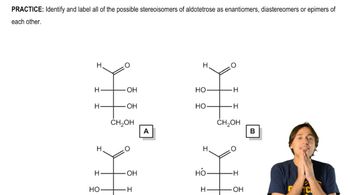
Epimers are a specific type of diastereomer that differ in configuration at only one stereogenic center. In the context of sugars, this means that two sugars can have the same molecular formula and differ only at one carbon atom's stereochemistry. Understanding epimers is crucial for identifying relationships between different sugars, such as determining which sugar is the C-4 epimer of another.
Recommended video:
Guided course
03:42
Identifying Types of Stereoisomers

D- and L- Configuration

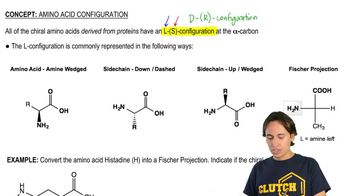
The D- and L- notation refers to the configuration of sugars based on the orientation of the hydroxyl group (-OH) on the penultimate carbon (the second-to-last carbon). D-sugars have the hydroxyl group on the right in a Fischer projection, while L-sugars have it on the left. This classification is essential for distinguishing between different sugar forms and understanding their structural relationships.
Recommended video:
Guided course
05:09
Representations of L-Configuration

Gulose

Gulose is a six-carbon sugar (hexose) that can exist in two forms: D-gulose and L-gulose. It is an aldohexose, meaning it contains an aldehyde group. Knowing the structure and stereochemistry of gulose is important for identifying its epimers, as well as for understanding its role in biological systems and its relationship to other sugars.
Recommended video:
Guided course
08:09
Which monosaccharides would produce aldaric acid?