
Ch. 2 - Acids and Bases: Central to Understanding Organic Chemistry
Bruice - Organic Chemistry 8th Edition
Bruice8th EditionOrganic ChemistryISBN: 9780135213711Not the one you use?Change textbook
Chapter 3, Problem 20a

Rank the ions (CH3NH2, HO, and F) from most basic to least basic.

Verified step by step guidance
1
Understand the concept of basicity: Basicity refers to the ability of a species to donate a pair of electrons (act as a base). The stronger the base, the more readily it donates electrons. Factors such as electronegativity, resonance, and steric hindrance influence basicity.
Analyze the electronegativity of the atoms involved: Electronegativity is a key factor in determining basicity. Less electronegative atoms hold onto their electrons less tightly, making them more willing to donate electron pairs. In this case, compare the electronegativities of C (carbon), N (nitrogen), O (oxygen), and F (fluorine).
Consider the stability of the conjugate acids: A stronger base will have a less stable conjugate acid. For example, the conjugate acid of −CH3 is CH4, which is relatively stable, while the conjugate acid of F− is HF, which is highly stable due to hydrogen bonding.
Evaluate the lone pair availability: The availability of lone pairs for donation is crucial. For example, −CH3 has a lone pair on carbon, which is less electronegative and more willing to donate electrons compared to −NH2, HO−, and F−.
Rank the ions based on the above factors: Using electronegativity, conjugate acid stability, and lone pair availability, rank the ions from most basic to least basic. The order will depend on the interplay of these factors, with −CH3 likely being the most basic and F− the least basic due to its high electronegativity and stable conjugate acid.

Verified video answer for a similar problem:

This video solution was recommended by our tutors as helpful for the problem above.
Video duration:
7m
Was this helpful?

Key Concepts

Here are the essential concepts you must grasp in order to answer the question correctly.

Basicity

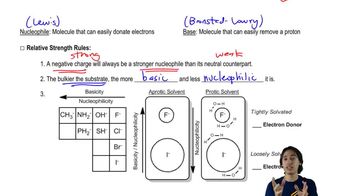
Basicity refers to the ability of a species to accept protons (H+) or donate electron pairs. In organic chemistry, basicity is influenced by the stability of the resulting conjugate acid and the electronegativity of the atom bearing the lone pair. Stronger bases are typically less stable as conjugate acids, leading to a higher tendency to accept protons.
Recommended video:
Guided course
06:21
Understanding the difference between basicity and nucleophilicity.

Electronegativity

Electronegativity is a measure of an atom's ability to attract and hold onto electrons. In the context of basicity, more electronegative atoms (like fluorine) are less likely to donate their lone pairs, making them weaker bases. Conversely, less electronegative atoms (like carbon in −CH3) are more willing to share their electrons, enhancing their basicity.
Recommended video:
Guided course
1:47
Electronegativity

Conjugate Acids

Conjugate acids are formed when a base accepts a proton. The stability of these conjugate acids plays a crucial role in determining the basicity of the original species. A more stable conjugate acid indicates a weaker base, while a less stable conjugate acid corresponds to a stronger base. Understanding the stability of these acids helps rank the basicity of the given ions.
Recommended video:
Guided course
03:27
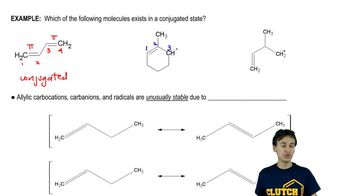
Conjugated states