Ch. 2 - Acids and Bases: Central to Understanding Organic Chemistry
Bruice - Organic Chemistry 8th Edition
Bruice8th EditionOrganic ChemistryISBN: 9780135213711Not the one you use?Change textbook
Chapter 3, Problem 46a

For each of the following compounds, indicate the pH at which
a. 50% of the compound is in a form that possesses a charge.
1. CH3CH2COOH (pKa = 4.9)
2. CH3N+H3 (pKa = 10.7)

Verified step by step guidance
1
Step 1: Understand the concept of pKa and its relationship to pH. The pKa value of a compound is the pH at which 50% of the compound exists in its protonated form and 50% in its deprotonated form. This is the point where the compound is in equilibrium between its charged and uncharged forms.
Step 2: For CH3CH2COOH (pKa = 4.9), recognize that this is a carboxylic acid. At pH = pKa, 50% of the carboxylic acid will be in its deprotonated form (CH3CH2COO⁻, which is charged) and 50% will remain in its protonated form (CH3CH2COOH, which is neutral). Therefore, the pH at which 50% of the compound is charged is equal to its pKa value.
Step 3: For CH3N+H3 (pKa = 10.7), recognize that this is an ammonium ion. At pH = pKa, 50% of the ammonium ion will be in its deprotonated form (CH3NH2, which is neutral) and 50% will remain in its protonated form (CH3N+H3, which is charged). Therefore, the pH at which 50% of the compound is charged is equal to its pKa value.
Step 4: Summarize the relationship for both compounds: The pH at which 50% of the compound is in a charged form is equal to the pKa value of the compound. This is a direct application of the Henderson-Hasselbalch equation, which describes the ratio of protonated to deprotonated species at a given pH.
Step 5: To solve similar problems, always identify the functional group responsible for the charge, locate the pKa value, and understand that at pH = pKa, the compound is 50% charged and 50% uncharged. This principle applies universally to acids and bases in organic chemistry.

Verified video answer for a similar problem:

This video solution was recommended by our tutors as helpful for the problem above.
Video duration:
3m
Was this helpful?

Key Concepts

Here are the essential concepts you must grasp in order to answer the question correctly.

pKa and pH Relationship

The pKa of a compound is the pH at which half of the species are deprotonated, meaning 50% exists in a charged form. This relationship is crucial for understanding acid-base equilibria, as it helps predict the protonation state of a compound at a given pH. For example, if the pH is equal to the pKa, the concentrations of the protonated and deprotonated forms are equal.
Recommended video:
Guided course
07:45
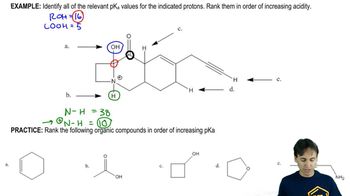
Identifying pKa values

Acid-Base Equilibrium

Acid-base equilibrium describes the balance between protonated (acidic) and deprotonated (basic) forms of a compound in solution. The position of this equilibrium is influenced by the pH of the solution and the pKa of the compound. Understanding this concept allows for the prediction of the predominant form of a compound at specific pH levels, which is essential for determining the charge state.
Recommended video:
Guided course
04:00
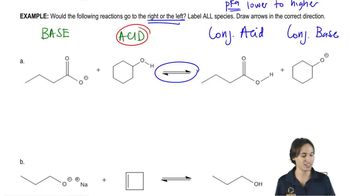
Determining Acid/Base Equilibrium

Charged vs. Neutral Species

In organic chemistry, the charge of a species can significantly affect its reactivity and solubility. Charged species, such as carboxylate ions or ammonium ions, often have different physical and chemical properties compared to their neutral counterparts. Recognizing when a compound exists in a charged form versus a neutral form is vital for predicting its behavior in various chemical environments.
Recommended video:
Guided course
01:34
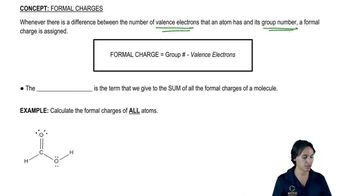
Calculating formal and net charge.