
Ch. 2 - Acids and Bases: Central to Understanding Organic Chemistry
Bruice - Organic Chemistry 8th Edition
Bruice8th EditionOrganic ChemistryISBN: 9780135213711Not the one you use?Change textbook
Chapter 3, Problem 34a,b

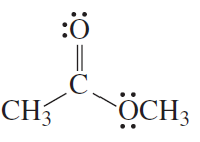
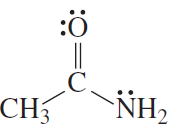
For each of the following compounds, indicate the atom that is protonated when an acid is added to a solution of the compound.
a. Structural formula of a compound showing a central carbon atom bonded to an oxygen atom and two methyl groups.
b. Structural formula of a compound showing a carbon atom bonded to a hydroxyl group, a methyl group, and an amine group.

Verified step by step guidance
1
Step 1: Analyze the structure of compound A. It contains a carbonyl group (C=O) and an ether group (-O-). The oxygen atoms in these functional groups are potential sites for protonation because they have lone pairs of electrons that can interact with a proton (H⁺).
Step 2: Determine which oxygen atom in compound A is more likely to be protonated. The carbonyl oxygen is more electronegative and has a higher electron density compared to the ether oxygen. Additionally, protonation of the carbonyl oxygen leads to resonance stabilization, making it the preferred site for protonation.
Step 3: Analyze the structure of compound B. It contains a carbonyl group (C=O) and an amine group (-NH). Both the oxygen in the carbonyl group and the nitrogen in the amine group are potential sites for protonation due to their lone pairs of electrons.
Step 4: Compare the likelihood of protonation for the oxygen and nitrogen atoms in compound B. The nitrogen atom in the amine group is more basic than the oxygen atom in the carbonyl group, meaning it is more likely to accept a proton. Protonation of the nitrogen atom does not disrupt resonance, making it the preferred site for protonation.
Step 5: Summarize the findings. In compound A, the carbonyl oxygen is protonated when an acid is added. In compound B, the nitrogen in the amine group is protonated when an acid is added.

Verified video answer for a similar problem:

This video solution was recommended by our tutors as helpful for the problem above.
Video duration:
3m
Was this helpful?

Key Concepts

Here are the essential concepts you must grasp in order to answer the question correctly.

Protonation

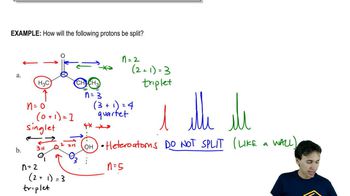
Protonation is the addition of a proton (H⁺) to a molecule, which can significantly alter its chemical properties. In organic chemistry, understanding which atom is protonated helps predict the behavior of the compound in acidic conditions. Typically, protonation occurs at sites with high electron density, such as lone pairs on nitrogen or oxygen atoms.
Recommended video:
Guided course
03:
Proton Splitting

Acidity and Basicity

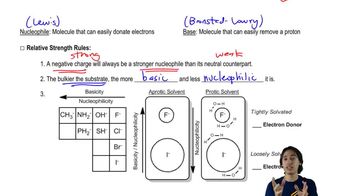
Acidity refers to the ability of a compound to donate protons, while basicity is the ability to accept protons. The strength of an acid is often determined by the stability of its conjugate base after proton donation. In the context of the given compounds, identifying the most basic site will indicate where protonation is likely to occur when an acid is added.
Recommended video:
Guided course
06:21
Understanding the difference between basicity and nucleophilicity.

Resonance Stabilization

Resonance stabilization occurs when a molecule can be represented by multiple valid Lewis structures, leading to increased stability. In the context of protonation, resonance can influence which atom is more favorable for protonation, as the resulting cation may be stabilized by delocalization of charge. This concept is crucial for predicting the outcome of acid-base reactions in organic compounds.
Recommended video:
Guided course
03:43
The radical stability trend.