Ch. 19 - More About Amines • Reactions of Heterocyclic Compounds
Bruice - Organic Chemistry 8th Edition
Bruice8th EditionOrganic ChemistryISBN: 9780135213711Not the one you use?Change textbook
Chapter 20, Problem 28

Pyrrole reacts with excess para-(N,N-dimethylamino)benzaldehyde to form a highly colored compound. Draw the structure of the colored compound.

Verified step by step guidance
1
Understand the reaction: Pyrrole is a five-membered aromatic heterocycle with a nitrogen atom. It is highly reactive in electrophilic aromatic substitution reactions due to the electron-donating nature of the nitrogen atom. Para-(N,N-dimethylamino)benzaldehyde contains an electron-donating N,N-dimethylamino group and an aldehyde functional group, making it an electrophile in this reaction.
Recognize the reaction type: This is a condensation reaction, specifically a type of electrophilic aromatic substitution followed by a series of steps leading to the formation of a conjugated system. Pyrrole reacts with the aldehyde group of para-(N,N-dimethylamino)benzaldehyde to form a conjugated product.
Determine the mechanism: The reaction begins with the nucleophilic attack of the pyrrole on the carbonyl carbon of the aldehyde group. This forms an intermediate that undergoes dehydration (loss of water) to form a double bond, resulting in a conjugated imine structure.
Consider the excess reagent: Since excess para-(N,N-dimethylamino)benzaldehyde is used, multiple aldehyde molecules can react with pyrrole. This leads to the formation of a highly conjugated system, which is responsible for the intense coloration of the product.
Draw the final structure: The final product is a conjugated compound where pyrrole is linked to multiple para-(N,N-dimethylamino)benzaldehyde units through imine bonds. The extended conjugation and the electron-donating N,N-dimethylamino groups contribute to the compound's color.

Verified video answer for a similar problem:

This video solution was recommended by our tutors as helpful for the problem above.
Was this helpful?

Key Concepts

Here are the essential concepts you must grasp in order to answer the question correctly.

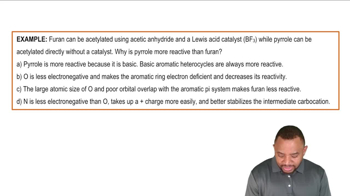
Pyrrole Structure and Reactivity

Pyrrole is a five-membered aromatic heterocycle containing a nitrogen atom. Its structure allows for nucleophilic attack due to the electron-rich nature of the nitrogen, making it reactive towards electrophiles. Understanding pyrrole's reactivity is crucial for predicting its behavior in reactions, such as with para-(N,N-dimethylamino)benzaldehyde.
Recommended video:
1:52
Reactions of Pyrrole, Furan, and Thiophene Example 1

Electrophilic Aromatic Substitution

Electrophilic aromatic substitution (EAS) is a fundamental reaction mechanism in organic chemistry where an electrophile replaces a hydrogen atom on an aromatic ring. In this case, the para-(N,N-dimethylamino)benzaldehyde acts as an electrophile, and recognizing how EAS occurs helps in determining the structure of the resulting compound formed from pyrrole.
Recommended video:

Color in Organic Compounds

The color of organic compounds often arises from the presence of conjugated systems, where alternating double and single bonds allow for delocalization of electrons. This delocalization can absorb visible light, leading to the appearance of color. Understanding how conjugation affects the electronic structure is essential for predicting the color of the compound formed in this reaction.
Recommended video:
Guided course
01:40
Defining meso compounds.