Ch. 19 - More About Amines • Reactions of Heterocyclic Compounds
Bruice - Organic Chemistry 8th Edition
Bruice8th EditionOrganic ChemistryISBN: 9780135213711Not the one you use?Change textbook
Chapter 20, Problem 11

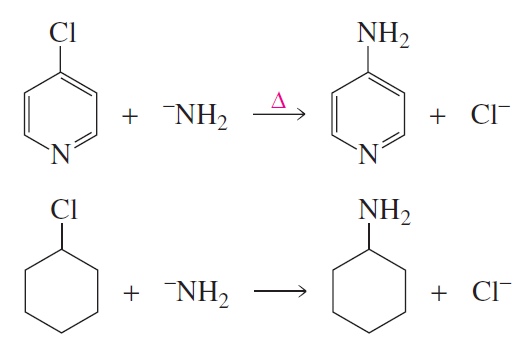
How do the mechanisms of the following reactions differ?
Chemical reaction mechanisms for nucleophilic aromatic substitution, showing two different aromatic compounds.

Verified step by step guidance
1
Step 1: Analyze the first reaction (i). The substrate is an aniline (benzene ring with an -NH2 group), and the reagent is Cl2. This reaction involves electrophilic aromatic substitution, where the chlorine acts as an electrophile and substitutes a hydrogen atom on the benzene ring. The -NH2 group is an activating group and directs the substitution to the ortho and para positions due to its electron-donating nature.
Step 2: Examine the second reaction (ii). The substrate is a bromopyridine (pyridine ring with a bromine atom), and the reagent is NaOCH3. This reaction involves nucleophilic aromatic substitution, where the bromine atom is replaced by the methoxy group (-OCH3). Pyridine is electron-deficient due to the nitrogen atom, making it susceptible to nucleophilic attack. The reaction proceeds via a Meisenheimer complex intermediate.
Step 3: Compare the mechanisms. Reaction (i) proceeds via an electrophilic aromatic substitution mechanism, which involves the generation of a carbocation intermediate stabilized by resonance. The -NH2 group enhances the reactivity of the benzene ring toward electrophiles. Reaction (ii), on the other hand, proceeds via nucleophilic aromatic substitution, which involves the formation of a negatively charged intermediate (Meisenheimer complex) before the bromine is displaced.
Step 4: Highlight the role of substituents. In reaction (i), the -NH2 group is an electron-donating group that activates the benzene ring and directs substitution to the ortho and para positions. In reaction (ii), the nitrogen atom in pyridine withdraws electron density, making the ring more susceptible to nucleophilic attack, and the bromine atom serves as a good leaving group.
Step 5: Summarize the key difference. The primary distinction between the two reactions is the type of substitution mechanism: electrophilic aromatic substitution in reaction (i) versus nucleophilic aromatic substitution in reaction (ii). The nature of the substituents and the reagents determines the mechanism and the outcome of each reaction.

Verified video answer for a similar problem:

This video solution was recommended by our tutors as helpful for the problem above.
Video duration:
4m
Was this helpful?

Key Concepts

Here are the essential concepts you must grasp in order to answer the question correctly.

Nucleophilic Aromatic Substitution (NAS)

Nucleophilic aromatic substitution is a reaction mechanism where a nucleophile replaces a leaving group on an aromatic ring. This process typically occurs when the aromatic compound has electron-withdrawing groups that stabilize the negative charge developed during the reaction. Understanding this mechanism is crucial for analyzing how different nucleophiles and leaving groups affect the reaction pathway and product formation.
Recommended video:
Guided course
02:10
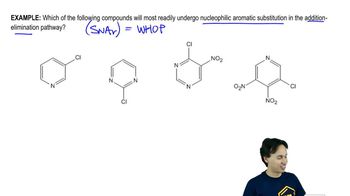
NAS in the addition-elimination pathway

Electrophilic Aromatic Substitution (EAS)

Electrophilic aromatic substitution is a mechanism where an electrophile replaces a hydrogen atom on an aromatic ring. In the presence of a strong electrophile, such as Cl2, the aromatic system undergoes a temporary disruption of its aromaticity, allowing for substitution. This concept is essential for understanding how reactions with halogens differ from those involving nucleophiles, as seen in the provided reactions.
Recommended video:

Leaving Groups

Leaving groups are atoms or groups that can depart from a molecule during a chemical reaction, facilitating the substitution process. The ability of a leaving group to stabilize the negative charge after departure is critical in determining the reaction's feasibility and rate. In the context of the reactions shown, the nature of the leaving group (Cl in the first reaction and Br in the second) influences the mechanism and outcome of the nucleophilic aromatic substitution.
Recommended video:
Guided course
07:22
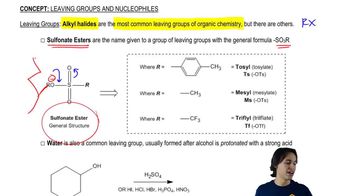
The 3 important leaving groups to know.