Ch. 19 - More About Amines • Reactions of Heterocyclic Compounds
Bruice - Organic Chemistry 8th Edition
Bruice8th EditionOrganic ChemistryISBN: 9780135213711Not the one you use?Change textbook
Chapter 20, Problem 36

Explain why pyrrole (pKa ~ 17) is a much stronger acid than ammonia (pKa = 36).
Comparison of pyrrole and ammonia acidity, showing pKa values of ~17 and 36, respectively, highlighting pyrrole's stronger acidity.

Verified step by step guidance
1
Step 1: Understand the concept of pKa. The pKa value is a measure of the acidity of a compound. A lower pKa value indicates a stronger acid, meaning the compound is more likely to donate a proton (H⁺).
Step 2: Compare the structures of pyrrole and ammonia. Pyrrole is an aromatic heterocyclic compound with a nitrogen atom in a five-membered ring, while ammonia (NH₃) is a simple molecule with a lone pair of electrons on nitrogen.
Step 3: Analyze the conjugate bases formed after deprotonation. When pyrrole loses a proton, the negative charge on nitrogen can delocalize into the aromatic ring, stabilizing the conjugate base through resonance. In contrast, ammonia's conjugate base (NH₂⁻) does not have resonance stabilization.
Step 4: Consider the role of aromaticity. Pyrrole is aromatic, and the delocalization of electrons in the ring contributes to its stability. The ability to maintain aromaticity after deprotonation further stabilizes pyrrole's conjugate base, making pyrrole a stronger acid.
Step 5: Evaluate the electronegativity and hybridization of nitrogen. In pyrrole, the nitrogen is sp² hybridized and part of the aromatic system, which affects its ability to donate a proton. In ammonia, the nitrogen is sp³ hybridized, and the lack of resonance stabilization makes it less acidic.

Verified video answer for a similar problem:

This video solution was recommended by our tutors as helpful for the problem above.
Video duration:
3m
Was this helpful?

Key Concepts

Here are the essential concepts you must grasp in order to answer the question correctly.

Acidity and pKa

Acidity is a measure of a compound's ability to donate protons (H+ ions). The pKa value quantifies this ability, with lower pKa values indicating stronger acids. Pyrrole, with a pKa of ~17, is significantly more acidic than ammonia, which has a pKa of 36, meaning pyrrole can more readily donate a proton compared to ammonia.
Recommended video:
Guided course
07:45
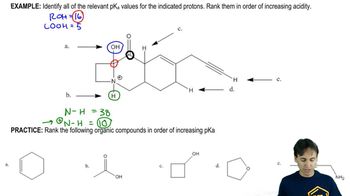
Identifying pKa values

Resonance Stabilization

Resonance stabilization occurs when a molecule can distribute its electron density across multiple structures, lowering its energy. In pyrrole, the negative charge formed after deprotonation can be delocalized over the nitrogen and the adjacent carbon atoms, stabilizing the conjugate base. This stabilization is not present in ammonia, making pyrrole a stronger acid.
Recommended video:
Guided course
03:43
The radical stability trend.

Aromaticity

Aromaticity refers to the enhanced stability of cyclic compounds with conjugated pi electron systems that follow Huckel's rule. Pyrrole is an aromatic compound, which contributes to its stability after losing a proton. In contrast, ammonia is not aromatic, and thus lacks this additional stabilization, further explaining the difference in acidity between the two compounds.
Recommended video:
Guided course
08:19
Intro to Aromaticity