Ch. 18 - Reactions of Benzene and Substituted Benzenes
Bruice - Organic Chemistry 8th Edition
Bruice8th EditionOrganic ChemistryISBN: 9780135213711Not the one you use?Change textbook
Chapter 19, Problem 60

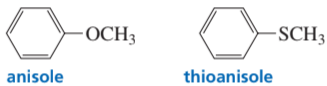
Why is anisole nitrated more rapidly than thioanisole under the same conditions?
Structural formulas of anisole and thioanisole, labeled with their names below each compound.

Verified step by step guidance
1
Understand the structures of anisole and thioanisole: Anisole is an aromatic compound with a methoxy group (-OCH₃) attached to the benzene ring, while thioanisole has a thiomethyl group (-SCH₃) attached to the benzene ring.
Analyze the electron-donating or withdrawing effects of the substituents: The methoxy group (-OCH₃) in anisole is an electron-donating group due to the lone pairs on the oxygen atom, which can participate in resonance with the benzene ring. In contrast, the thiomethyl group (-SCH₃) in thioanisole is less effective at donating electrons because sulfur is less electronegative and less efficient at resonance donation compared to oxygen.
Consider the activation of the benzene ring: The electron-donating effect of the methoxy group in anisole increases the electron density on the benzene ring, particularly at the ortho and para positions, making it more reactive toward electrophilic aromatic substitution reactions like nitration. The thiomethyl group in thioanisole also donates electrons but to a lesser extent, resulting in a less activated benzene ring.
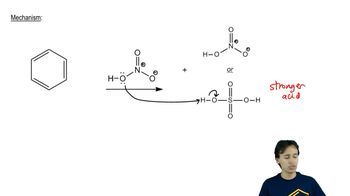
Relate this to the nitration reaction: Nitration involves the generation of the nitronium ion (NO₂⁺), a strong electrophile, which reacts with the electron-rich benzene ring. Since anisole has a higher electron density due to the stronger electron-donating effect of the methoxy group, it undergoes nitration more rapidly than thioanisole under the same conditions.
Conclude the comparison: The difference in reactivity is primarily due to the difference in the electron-donating abilities of the substituents (-OCH₃ vs. -SCH₃). The methoxy group in anisole activates the benzene ring more effectively than the thiomethyl group in thioanisole, leading to faster nitration of anisole.

Verified video answer for a similar problem:

This video solution was recommended by our tutors as helpful for the problem above.
Video duration:
5m
Was this helpful?

Key Concepts

Here are the essential concepts you must grasp in order to answer the question correctly.

Nitration Mechanism

Nitration is an electrophilic aromatic substitution reaction where a nitro group is introduced into an aromatic compound. The reaction involves the generation of a nitronium ion (NO2+) that acts as the electrophile. The rate of nitration depends on the electron density of the aromatic ring, which is influenced by substituents attached to it.
Recommended video:
Guided course
06:09
EAS Nitration

Electron Donating and Withdrawing Groups

Substituents on an aromatic ring can either donate or withdraw electron density. Electron-donating groups, like the methoxy group in anisole, increase the electron density of the ring, making it more reactive towards electrophiles. In contrast, thioanisole has a sulfur atom that, while also donating electrons, does so less effectively than the methoxy group, leading to slower nitration.
Recommended video:
Guided course
02:37
Donating vs Withdrawing Groups

Resonance Effects

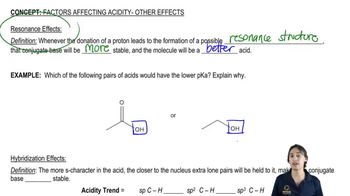
Resonance effects describe how the distribution of electrons in a molecule can stabilize or destabilize certain structures. In anisole, the methoxy group can delocalize electron density into the aromatic ring through resonance, enhancing its reactivity. Thioanisole's sulfur atom does not stabilize the positive charge in the intermediate as effectively, resulting in a slower reaction rate compared to anisole.
Recommended video:
Guided course
03:32
Understanding Resonance Effects