Ch. 18 - Reactions of Benzene and Substituted Benzenes
Bruice - Organic Chemistry 8th Edition
Bruice8th EditionOrganic ChemistryISBN: 9780135213711Not the one you use?Change textbook
Chapter 19, Problem 20a

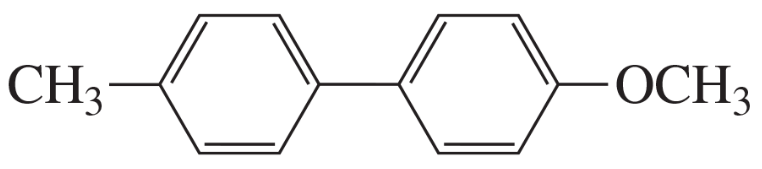
What products are obtained from the reaction of the following compounds with one equivalent of Br2, using FeBr3 as a catalyst?
a.

Verified step by step guidance
1
Step 1: Identify the functional groups and substituents on the aromatic rings. The compound consists of two benzene rings connected by a single bond. One ring has a methyl group (-CH3) substituent, and the other has a methoxy group (-OCH3) substituent.
Step 2: Understand the role of FeBr3 as a catalyst. FeBr3 is a Lewis acid that facilitates the generation of the electrophile, Br+, from Br2. This electrophile will react with the aromatic rings in an electrophilic aromatic substitution reaction.
Step 3: Determine the directing effects of the substituents. The methyl group (-CH3) is an electron-donating group and activates the benzene ring, directing substitution to the ortho and para positions. The methoxy group (-OCH3) is also an electron-donating group and strongly activates the benzene ring, directing substitution to the ortho and para positions.
Step 4: Predict the most reactive site. The methoxy group (-OCH3) is a stronger activator than the methyl group (-CH3), so the bromination will preferentially occur on the ring with the methoxy group. The para position relative to the methoxy group is sterically favored over the ortho positions.
Step 5: Conclude the reaction outcome. Bromination will occur at the para position of the benzene ring with the methoxy group, resulting in a product where a bromine atom is added to the para position relative to the -OCH3 group.

Verified video answer for a similar problem:

This video solution was recommended by our tutors as helpful for the problem above.
Video duration:
2m
Was this helpful?

Key Concepts

Here are the essential concepts you must grasp in order to answer the question correctly.

Electrophilic Aromatic Substitution

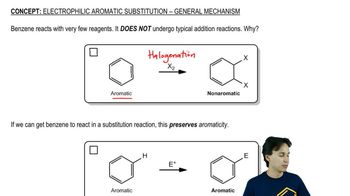
Electrophilic aromatic substitution (EAS) is a fundamental reaction in organic chemistry where an electrophile replaces a hydrogen atom on an aromatic ring. In this case, bromine (Br2) acts as the electrophile, and the presence of a catalyst like FeBr3 enhances the reaction by generating a more reactive bromonium ion. Understanding EAS is crucial for predicting the products formed when aromatic compounds react with bromine.
Recommended video:

Catalysis

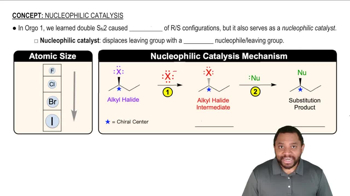
Catalysis involves the acceleration of a chemical reaction by a substance called a catalyst, which is not consumed in the reaction. In this scenario, FeBr3 serves as a Lewis acid catalyst that facilitates the generation of the bromonium ion from Br2, making the electrophilic attack on the aromatic compound more favorable. Recognizing the role of catalysts is essential for understanding reaction mechanisms and product formation.
Recommended video:
2:31
Nucleophilic Catalysis Concept 1

Regioselectivity

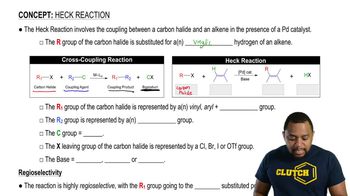
Regioselectivity refers to the preference of a chemical reaction to occur at one location over another in a molecule. In the context of EAS reactions, the substituents already present on the aromatic ring can influence where the bromine will add, leading to different products. Analyzing the structure of the starting compounds is vital for predicting the regioselective outcomes of the reaction with Br2.
Recommended video:
Guided course
05:09
Heck Reaction