Ch. 18 - Reactions of Benzene and Substituted Benzenes
Bruice - Organic Chemistry 8th Edition
Bruice8th EditionOrganic ChemistryISBN: 9780135213711Not the one you use?Change textbook
Chapter 19, Problem 57f

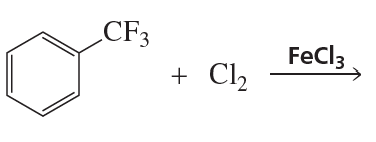
What are the products of the following reactions?
f. Chemical reaction diagram showing a trifluoromethylbenzene reacting with chlorine in the presence of iron(III) chloride.

Verified step by step guidance
1
Step 1: Recognize the type of reaction. This is an electrophilic aromatic substitution reaction where bromine (Br2) reacts with the aromatic ring in the presence of a Lewis acid catalyst (FeBr3). The Lewis acid FeBr3 helps generate the electrophile Br+.
Step 2: Analyze the structure of the aromatic compound. The benzene ring is substituted with a trichloromethyl group (-CCl3), which is an electron-withdrawing group. Electron-withdrawing groups deactivate the ring and direct substitution to the meta position.
Step 3: Generate the electrophile. FeBr3 reacts with Br2 to form the bromonium ion (Br+), which acts as the electrophile in this reaction. The reaction can be represented as: FeBr3+Br2FeBr4-+Br+
Step 4: Determine the site of substitution. The trichloromethyl group (-CCl3) directs the bromine to the meta position due to its electron-withdrawing nature. The bromonium ion (Br+) will attack the meta position relative to the -CCl3 group.
Step 5: Complete the reaction mechanism. After the bromonium ion (Br+) substitutes at the meta position, the aromaticity of the benzene ring is restored by the loss of a proton (H+). The final product is a brominated benzene ring with the bromine at the meta position relative to the -CCl3 group.

Verified video answer for a similar problem:

This video solution was recommended by our tutors as helpful for the problem above.
Video duration:
3m
Was this helpful?

Key Concepts

Here are the essential concepts you must grasp in order to answer the question correctly.

Electrophilic Aromatic Substitution (EAS)

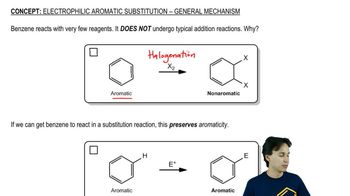
Electrophilic Aromatic Substitution is a fundamental reaction in organic chemistry where an electrophile replaces a hydrogen atom on an aromatic ring. This process typically involves the formation of a sigma complex, where the aromaticity is temporarily lost, followed by deprotonation to restore aromaticity. Understanding EAS is crucial for predicting the products of reactions involving aromatic compounds.
Recommended video:

Role of Lewis Acids

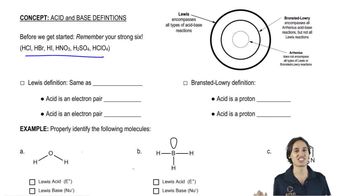
Lewis acids, such as FeBr3 in this reaction, are substances that can accept an electron pair from a Lewis base. In the context of EAS, FeBr3 acts as a catalyst by forming a more reactive electrophile from Br2, facilitating the substitution reaction. Recognizing the role of Lewis acids is essential for understanding how certain reactions proceed and the stability of intermediates formed.
Recommended video:
Guided course
02:49
The Lewis definition of acids and bases.

Regioselectivity in Substitution Reactions

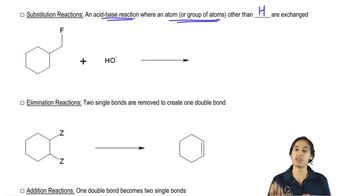
Regioselectivity refers to the preference of a chemical reaction to yield one structural isomer over others when multiple possibilities exist. In EAS reactions, the presence of substituents on the aromatic ring can influence the position where the electrophile attacks, leading to ortho, meta, or para products. Analyzing the substituents' electronic effects is vital for predicting the major products of the reaction.
Recommended video:
Guided course
01:34
Recognizing Substitution Reactions.