Ch. 18 - Reactions of Benzene and Substituted Benzenes
Bruice - Organic Chemistry 8th Edition
Bruice8th EditionOrganic ChemistryISBN: 9780135213711Not the one you use?Change textbook
Chapter 19, Problem 52b

Show how the following compounds can be synthesized from benzene:
b. m-chloroethylbenzene

Verified step by step guidance
1
Step 1: Begin with benzene as the starting material. Benzene is an aromatic compound with alternating double bonds in a six-membered ring.
Step 2: Perform a Friedel-Crafts alkylation reaction to introduce the ethyl group onto the benzene ring. Use ethyl chloride (C₂H₅Cl) and a Lewis acid catalyst such as AlCl₃. This reaction will yield ethylbenzene.
Step 3: Carry out a chlorination reaction to introduce a chlorine atom onto the benzene ring. Use Cl₂ and a catalyst such as FeCl₃. This reaction will produce a mixture of ortho-, meta-, and para-chloroethylbenzene.
Step 4: Separate the meta-chloroethylbenzene from the mixture using techniques such as fractional distillation or chromatography, as the meta-isomer is the desired product.
Step 5: Confirm the structure of the synthesized m-chloroethylbenzene using spectroscopic methods such as NMR or IR to ensure the correct substitution pattern on the benzene ring.

Verified video answer for a similar problem:

This video solution was recommended by our tutors as helpful for the problem above.
Video duration:
7m
Was this helpful?

Key Concepts

Here are the essential concepts you must grasp in order to answer the question correctly.

Electrophilic Aromatic Substitution (EAS)

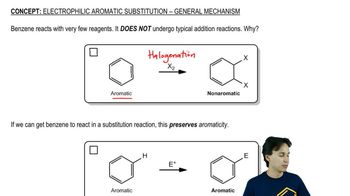
Electrophilic Aromatic Substitution is a fundamental reaction in organic chemistry where an electrophile replaces a hydrogen atom on an aromatic ring. This process is crucial for synthesizing various aromatic compounds, including m-chloroethylbenzene from benzene. The reaction typically involves the generation of a positively charged intermediate, which then loses a proton to restore aromaticity.
Recommended video:

Regioselectivity in Substitution Reactions

Regioselectivity refers to the preference of a chemical reaction to yield one structural isomer over others when multiple possibilities exist. In the case of m-chloroethylbenzene synthesis, understanding the directing effects of substituents on the benzene ring is essential. The presence of an ethyl group directs the incoming electrophile to the meta position relative to itself, leading to the desired product.
Recommended video:
Guided course
01:34
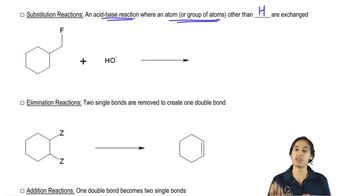
Recognizing Substitution Reactions.

Chlorination of Aromatic Compounds

Chlorination is a specific type of electrophilic aromatic substitution where chlorine is introduced into an aromatic compound. This reaction often requires a catalyst, such as iron(III) chloride, to generate the electrophilic chlorine species. In the synthesis of m-chloroethylbenzene, chlorination occurs after the ethyl group has been introduced, allowing for the selective formation of the meta product.
Recommended video:
Guided course
08:19
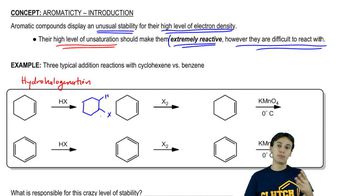
Intro to Aromaticity