Ch. 18 - Reactions of Benzene and Substituted Benzenes
Bruice - Organic Chemistry 8th Edition
Bruice8th EditionOrganic ChemistryISBN: 9780135213711Not the one you use?Change textbook
Chapter 19, Problem 23b

Show how the following compounds can be synthesized from benzene:
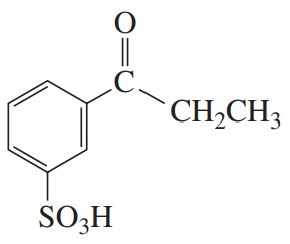
b. Chemical structure of a compound derived from benzene, featuring a sulfonic acid and an ethyl group attached to a carbonyl.

Verified step by step guidance
1
Step 1: Begin with benzene as the starting material. Perform sulfonation by reacting benzene with concentrated sulfuric acid (H₂SO₄) and fuming sulfuric acid (SO₃). This introduces a sulfonic acid group (-SO₃H) onto the benzene ring, forming benzenesulfonic acid.
Step 2: To ensure the correct positioning of the substituents, recognize that the sulfonic acid group is a meta-directing group. This means that subsequent electrophilic substitution reactions will favor the meta position relative to the -SO₃H group.
Step 3: Perform Friedel-Crafts acylation to introduce the acetyl group (-COCH₃) at the meta position. React benzenesulfonic acid with acetyl chloride (CH₃COCl) in the presence of a Lewis acid catalyst such as aluminum chloride (AlCl₃). This reaction forms the desired compound with the acetyl group at the meta position relative to the sulfonic acid group.
Step 4: Carefully isolate and purify the product to ensure the correct compound is obtained. Techniques such as recrystallization or chromatography may be used.
Step 5: Verify the structure of the final product using spectroscopic methods such as NMR or IR to confirm the presence of the sulfonic acid group and the acetyl group in the correct positions on the benzene ring.

Verified video answer for a similar problem:

This video solution was recommended by our tutors as helpful for the problem above.
Video duration:
5m
Was this helpful?

Key Concepts

Here are the essential concepts you must grasp in order to answer the question correctly.

Electrophilic Aromatic Substitution (EAS)

Electrophilic Aromatic Substitution is a fundamental reaction in organic chemistry where an electrophile replaces a hydrogen atom on an aromatic ring. This process is crucial for synthesizing various aromatic compounds, as it allows for the introduction of different functional groups onto the benzene ring. The reaction typically involves the formation of a sigma complex, followed by deprotonation to restore aromaticity.
Recommended video:

Sulfonation of Aromatic Compounds

Sulfonation is a specific type of EAS where a sulfonyl group (SO3H) is introduced to an aromatic compound, such as benzene. This reaction is usually carried out using sulfur trioxide (SO3) or fuming sulfuric acid (oleum) as the sulfonating agent. The resulting product, like p-toluene sulfonic acid, is important in various applications, including as a precursor for further chemical transformations.
Recommended video:
Guided course
08:19
Intro to Aromaticity

Reactivity of Substituted Aromatic Compounds

The reactivity of substituted aromatic compounds in EAS reactions is influenced by the nature of the substituents already present on the ring. Electron-donating groups, such as alkyl groups, activate the ring and direct incoming electrophiles to the ortho and para positions, while electron-withdrawing groups deactivate the ring and direct electrophiles to the meta position. Understanding these effects is essential for predicting the outcomes of synthetic routes involving aromatic compounds.
Recommended video:
Guided course
08:19
Intro to Aromaticity