Ch. 18 - Reactions of Benzene and Substituted Benzenes
Bruice - Organic Chemistry 8th Edition
Bruice8th EditionOrganic ChemistryISBN: 9780135213711Not the one you use?Change textbook
Chapter 19, Problem 24h

Show how each of the following compounds can be synthesized from benzene:
h. m-bromopropylbenzene

Verified step by step guidance
1
Step 1: Begin with benzene as the starting material. Benzene is a simple aromatic compound with the formula \( C_6H_6 \).
Step 2: Perform a Friedel-Crafts alkylation to introduce a propyl group onto the benzene ring. Use propyl chloride (\( CH_3CH_2CH_2Cl \)) as the alkylating agent and aluminum chloride (\( AlCl_3 \)) as the Lewis acid catalyst. This will yield propylbenzene.
Step 3: Brominate the propylbenzene to introduce a bromine atom at the meta position relative to the propyl group. Use bromine (\( Br_2 \)) in the presence of a Lewis acid catalyst such as ferric bromide (\( FeBr_3 \)). The propyl group is an electron-donating group, which directs the bromination to the meta position.
Step 4: Verify the structure of the product, m-bromopropylbenzene, to ensure that the bromine atom is located at the meta position relative to the propyl group on the benzene ring.
Step 5: Purify the product using appropriate techniques such as recrystallization or column chromatography to isolate m-bromopropylbenzene in its pure form.

Verified video answer for a similar problem:

This video solution was recommended by our tutors as helpful for the problem above.
Video duration:
3m
Was this helpful?

Key Concepts

Here are the essential concepts you must grasp in order to answer the question correctly.

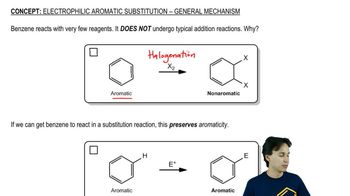
Electrophilic Aromatic Substitution

Electrophilic aromatic substitution (EAS) is a fundamental reaction in organic chemistry where an electrophile replaces a hydrogen atom on an aromatic ring. This process is crucial for synthesizing various aromatic compounds, including m-bromopropylbenzene from benzene. Understanding the mechanism of EAS, including the role of catalysts and the stability of intermediates, is essential for predicting the outcomes of such reactions.
Recommended video:

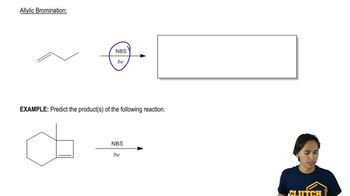
Bromination of Aromatic Compounds

Bromination is a specific type of electrophilic aromatic substitution where bromine is introduced into an aromatic compound. This reaction typically requires a brominating agent, such as Br2, and a Lewis acid catalyst like FeBr3. Recognizing how to control the regioselectivity of bromination is vital, especially for directing the bromine to the meta position in m-bromopropylbenzene.
Recommended video:
Guided course
00:54
Mechanism of Allylic Bromination.

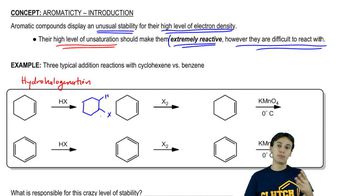
Alkylation of Aromatic Compounds

Alkylation involves the introduction of an alkyl group into an aromatic ring, often through Friedel-Crafts alkylation. This reaction typically uses an alkyl halide and a strong Lewis acid catalyst. Understanding the reactivity of different alkyl groups and the potential for rearrangements is important for successfully synthesizing compounds like m-bromopropylbenzene from benzene.
Recommended video:
Guided course
08:19
Intro to Aromaticity