Ch. 18 - Reactions of Benzene and Substituted Benzenes
Bruice - Organic Chemistry 8th Edition
Bruice8th EditionOrganic ChemistryISBN: 9780135213711Not the one you use?Change textbook
Chapter 19, Problem 48a,b

Draw the product(s) of each of the following reactions:
a. benzoic acid + HNO3/H2SO4
b. isopropylbenzene + Cl2 + FeCl3

Verified step by step guidance
1
Step 1: Analyze the reaction conditions for part (a). The reagents HNO3 (nitric acid) and H2SO4 (sulfuric acid) indicate a nitration reaction, which is an electrophilic aromatic substitution. Benzoic acid is the substrate, and the nitro group (-NO2) will be introduced onto the benzene ring.
Step 2: Determine the directing effects of the substituent on benzoic acid. The carboxylic acid group (-COOH) is an electron-withdrawing group and a meta-director. This means the nitro group will preferentially substitute at the meta position relative to the -COOH group.
Step 3: Draw the product for part (a). The benzene ring of benzoic acid will have a nitro group (-NO2) added at the meta position relative to the carboxylic acid group.
Step 4: Analyze the reaction conditions for part (b). The reagents Cl2 and FeCl3 indicate a chlorination reaction, which is another example of electrophilic aromatic substitution. Isopropylbenzene (cumene) is the substrate, and a chlorine atom will be introduced onto the benzene ring.
Step 5: Determine the directing effects of the substituent on isopropylbenzene. The isopropyl group (-CH(CH3)2) is an electron-donating group and an ortho/para-director. This means the chlorine atom will preferentially substitute at the ortho or para positions relative to the isopropyl group. Draw the product with chlorine added at one of these positions.

Verified video answer for a similar problem:

This video solution was recommended by our tutors as helpful for the problem above.
Video duration:
3m
Was this helpful?

Key Concepts

Here are the essential concepts you must grasp in order to answer the question correctly.

Electrophilic Aromatic Substitution (EAS)

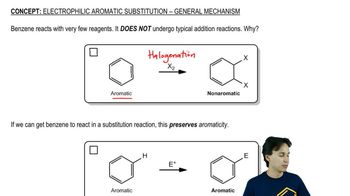
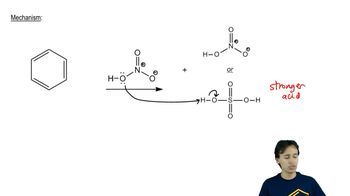
Electrophilic Aromatic Substitution is a fundamental reaction in organic chemistry where an electrophile replaces a hydrogen atom on an aromatic ring. In the context of the question, benzoic acid reacts with a mixture of nitric acid and sulfuric acid, generating a nitronium ion (NO2+) that acts as the electrophile, leading to nitration of the aromatic ring.
Recommended video:

Nitration of Benzoic Acid

The nitration of benzoic acid involves the introduction of a nitro group (-NO2) into the aromatic ring. The position of substitution is influenced by the electron-withdrawing carboxylic acid group, which directs the electrophile to the meta position relative to itself, resulting in the formation of meta-nitrobenzoic acid as a product.
Recommended video:
Guided course
06:09
EAS Nitration

Free Radical Halogenation

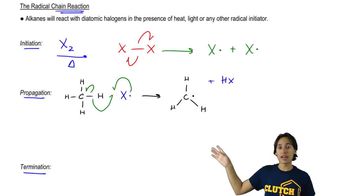
Free radical halogenation is a reaction where alkanes or aromatic compounds react with halogens in the presence of a catalyst to form haloalkanes or haloaromatic compounds. In the case of isopropylbenzene (cumene) reacting with chlorine in the presence of FeCl3, the reaction proceeds via a free radical mechanism, leading to the formation of chlorinated products, typically at the benzylic position.
Recommended video:
Guided course
12:11
Radical Chain Reaction Mechanism.