Ch. 18 - Reactions of Benzene and Substituted Benzenes
Bruice - Organic Chemistry 8th Edition
Bruice8th EditionOrganic ChemistryISBN: 9780135213711Not the one you use?Change textbook
Chapter 19, Problem 11c

Draw a structure for each of the following:
c. 4-bromo-3-chloroaniline

Verified step by step guidance
1
Step 1: Begin by identifying the functional groups present in the molecule depicted in the image. Look for common groups such as alcohols, amines, carboxylic acids, or ketones.
Step 2: Determine the connectivity of the atoms. This involves understanding how the atoms are bonded together, which can be inferred from the image. Pay attention to the number of bonds each atom forms, especially carbon, which typically forms four bonds.
Step 3: Consider the stereochemistry if applicable. If the image indicates any chiral centers or stereoisomers, make sure to represent them accurately in your structure.
Step 4: Use the information from the image to draw the skeletal structure. This involves placing the atoms in the correct positions and connecting them with lines to represent bonds.
Step 5: Double-check your structure for accuracy. Ensure that all valencies are satisfied, and the structure matches the image provided. Verify that the functional groups are correctly represented and that any stereochemistry is accurately depicted.

Verified video answer for a similar problem:

This video solution was recommended by our tutors as helpful for the problem above.
Video duration:
1m
Was this helpful?

Key Concepts

Here are the essential concepts you must grasp in order to answer the question correctly.

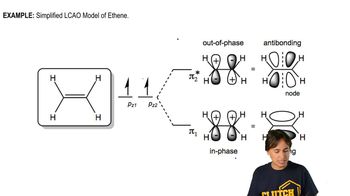
Molecular Structure

Molecular structure refers to the arrangement of atoms within a molecule, including the types of bonds (single, double, or triple) and the spatial orientation of these atoms. Understanding molecular structure is crucial for predicting the chemical properties and reactivity of compounds. It often involves using tools like Lewis structures, skeletal formulas, or 3D models to visualize how atoms are connected.
Recommended video:
Guided course
08:41
Review of Molecular Orbitals

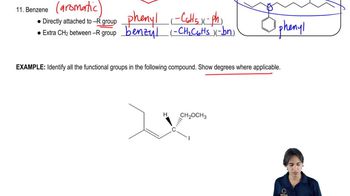
Functional Groups

Functional groups are specific groups of atoms within molecules that are responsible for the characteristic chemical reactions of those molecules. They determine the properties and reactivity of organic compounds. Recognizing functional groups is essential for drawing structures, as they influence how a molecule interacts with other substances and can dictate the overall behavior of the compound in chemical reactions.
Recommended video:
Guided course
02:36
Identifying Functional Groups

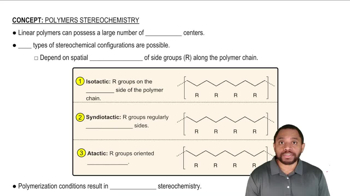
Stereochemistry

Stereochemistry is the study of the spatial arrangement of atoms in molecules and how this affects their chemical behavior. It includes concepts such as chirality, which describes molecules that cannot be superimposed on their mirror images. Understanding stereochemistry is vital for accurately drawing structures, especially for compounds with multiple stereocenters, as it impacts the physical and biological properties of the molecules.
Recommended video:
1:38
Polymer Stereochemistry Concept 1