Ch. 17 - Reactions at the Alpha-Carbon
Bruice - Organic Chemistry 8th Edition
Bruice8th EditionOrganic ChemistryISBN: 9780135213711Not the one you use?Change textbook
Chapter 18, Problem 67c

The Reformatsky reaction is an addition reaction in which an organozinc reagent is used instead of a Grignard reagent to add to the carbonyl group of an aldehyde or a ketone. Because the organozinc reagent is less reactive than a Grignard reagent, a nucleophilic addition to the ester group does not occur.
The organozinc reagent is prepared by treating an α-bromo ester with zinc.

Describe how each of the following compounds can be prepared, using a Reformatsky reaction:
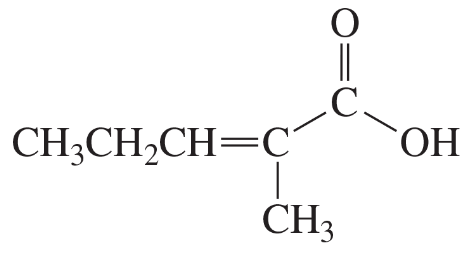
c.

Verified step by step guidance
1
Identify the target compound that needs to be synthesized using the Reformatsky reaction. This will typically involve recognizing the carbonyl compound (aldehyde or ketone) and the ester that will form the organozinc reagent.
Determine the structure of the alpha-bromo ester needed to form the organozinc reagent. The alpha-bromo ester should have the same carbon skeleton as the desired product, minus the carbonyl group.
React the alpha-bromo ester with zinc metal to form the organozinc reagent. This step involves the insertion of zinc into the carbon-bromine bond, creating a nucleophilic organozinc species.
Perform the nucleophilic addition of the organozinc reagent to the carbonyl compound (aldehyde or ketone). This step involves the organozinc reagent attacking the electrophilic carbon of the carbonyl group, forming a new carbon-carbon bond.
Finally, perform a workup step, typically involving the addition of an acid, to protonate the alkoxide intermediate and yield the desired beta-hydroxy ester product.

Verified video answer for a similar problem:

This video solution was recommended by our tutors as helpful for the problem above.
Video duration:
7m
Was this helpful?

Key Concepts

Here are the essential concepts you must grasp in order to answer the question correctly.

Reformatsky Reaction

The Reformatsky reaction is a chemical reaction that involves the addition of an organozinc reagent to a carbonyl compound, typically an aldehyde or ketone. This reaction is notable for using organozinc reagents, which are less reactive than Grignard reagents, allowing for selective reactions without unwanted side reactions, such as nucleophilic addition to esters.
Recommended video:
Guided course
05:09
Heck Reaction

Organozinc Reagents

Organozinc reagents are organometallic compounds that contain a carbon-zinc bond. They are generally less reactive than Grignard reagents, making them useful in reactions where controlled reactivity is desired. These reagents are typically prepared by reacting zinc with alkyl or aryl halides, such as a-bromo esters, which are crucial for the Reformatsky reaction.
Recommended video:

Nucleophilic Addition

Nucleophilic addition is a fundamental reaction mechanism in organic chemistry where a nucleophile attacks an electrophilic carbon atom, typically in a carbonyl group. In the context of the Reformatsky reaction, the reduced reactivity of organozinc reagents prevents unwanted nucleophilic addition to ester groups, allowing for more selective reactions with aldehydes and ketones.
Recommended video:
Guided course
08:27
Nucleophilic Addition
Related Practice
Textbook Question

Indicate how the following compounds can be synthesized from cyclohexanone and any other necessary reagents:

d.

2
views

Textbook Question

Indicate how each of the following compounds can be synthesized from the given starting material and any other necessary reagents:

b.

1
views
Textbook Question

The ketone whose 1H NMR spectrum is shown here was obtained as the product of an acetoacetic ester synthesis. What alkyl halide was used in the synthesis?

<IMAGE>

2
views
Textbook Question

The Reformatsky reaction is an addition reaction in which an organozinc reagent is used instead of a Grignard reagent to add to the carbonyl group of an aldehyde or a ketone. Because the organozinc reagent is less reactive than a Grignard reagent, a nucleophilic addition to the ester group does not occur. The organozinc reagent is prepared by treating an α-bromo ester with zinc.

Describe how each of the following compounds can be prepared, using a Reformatsky reaction:

a.

5
views
Textbook Question

Compound A with molecular formula C6H10 has two peaks in its 1H NMR spectrum, both of which are singlets (with ratio 9 : 1). Compound A reacts with an acidic aqueous solution containing mercuric sulfate to form compound B, which gives a positive iodoform test (Problem 58) and has an 1H NMR spectrum that shows two singlets (with ratio 3 : 1). Identify A and B.

3
views
Textbook Question

Indicate how each of the following compounds can be synthesized from the given starting material and any other necessary reagents:

c.

1
views