Ch. 17 - Reactions at the Alpha-Carbon
Bruice - Organic Chemistry 8th Edition
Bruice8th EditionOrganic ChemistryISBN: 9780135213711Not the one you use?Change textbook
Chapter 18, Problem 25c

Describe how the following compounds can be prepared using an aldol addition in the first step of the synthesis:
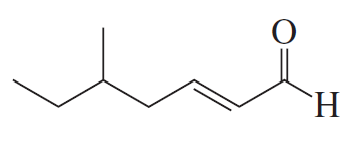
c. Chemical structure illustrating an aldol condensation product with a hydroxyl group and a carbonyl group.

Verified step by step guidance
1
Step 1: Identify the target molecule and recognize the aldol addition pattern. The compound shown contains an α,β-unsaturated carbonyl group, which suggests it could be formed via an aldol condensation reaction. The aldol addition step involves forming a β-hydroxy carbonyl intermediate.
Step 2: Determine the starting materials for the aldol addition. The target molecule can be synthesized by combining two carbonyl compounds: one acting as the enolate donor and the other as the electrophilic acceptor. In this case, the enolate donor could be 3,3-dimethylbutanal, and the electrophilic acceptor could be butanal.
Step 3: Generate the enolate ion. Under basic conditions (e.g., NaOH or KOH), the α-hydrogen of 3,3-dimethylbutanal is deprotonated to form the enolate ion. This enolate is nucleophilic and ready to attack the electrophilic carbonyl carbon of butanal.
Step 4: Perform the aldol addition reaction. The enolate ion attacks the carbonyl carbon of butanal, forming a new C-C bond. This results in a β-hydroxy carbonyl intermediate, which is the product of the aldol addition step.
Step 5: Dehydrate the β-hydroxy carbonyl intermediate. Under heating or acidic/basic conditions, the intermediate undergoes dehydration (loss of water) to form the α,β-unsaturated carbonyl compound shown in the target molecule. This step completes the aldol condensation process.

Verified video answer for a similar problem:

This video solution was recommended by our tutors as helpful for the problem above.
Video duration:
3m
Was this helpful?

Key Concepts

Here are the essential concepts you must grasp in order to answer the question correctly.

Aldol Addition

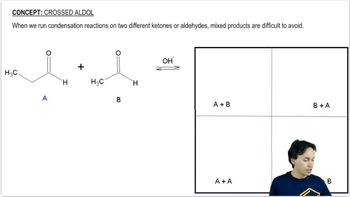
Aldol addition is a reaction between two carbonyl compounds, typically aldehydes or ketones, in the presence of a base. This reaction results in the formation of a β-hydroxy carbonyl compound, known as an aldol. The process involves the nucleophilic attack of an enolate ion on the carbonyl carbon of another molecule, leading to the formation of a new carbon-carbon bond.
Recommended video:
Guided course
09:51
Crossed Aldol

Enolate Ion

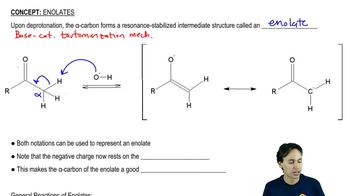
An enolate ion is a resonance-stabilized anion formed from a carbonyl compound when a base abstracts an alpha hydrogen. This ion is a key intermediate in aldol reactions, as it acts as a nucleophile that can attack another carbonyl compound. The stability of the enolate ion is influenced by the structure of the carbonyl compound and the nature of the base used.
Recommended video:
Guided course
02:26
Formation of Enolates

Aldol Condensation

Aldol condensation is a subsequent reaction that follows aldol addition, where the β-hydroxy carbonyl compound undergoes dehydration to form an α,β-unsaturated carbonyl compound. This step is driven by the loss of water and is often favored at elevated temperatures. The resulting compound has enhanced stability due to conjugation between the double bond and the carbonyl group, making it a valuable product in organic synthesis.
Recommended video:
Guided course
09:51
Crossed Aldol