Ch. 16 - Reactions of Aldehydes and Ketones • More Reactions of Carboxylic Acid Derivatives
Bruice - Organic Chemistry 8th Edition
Bruice8th EditionOrganic ChemistryISBN: 9780135213711Not the one you use?Change textbook
Chapter 17, Problem 20a,b

What alcohols are obtained from the reduction of the following compounds with sodium borohydride?
a. 2-methylpropanal
b. cyclohexanone

Verified step by step guidance
1
Identify the functional group in each compound. For 2-methylpropanal, the functional group is an aldehyde (-CHO). For cyclohexanone, the functional group is a ketone (C=O).
Understand the role of sodium borohydride (NaBH₄). It is a reducing agent that selectively reduces aldehydes and ketones to their corresponding alcohols by adding hydrogen atoms to the carbonyl group.
For 2-methylpropanal, the aldehyde group (-CHO) will be reduced to a primary alcohol (-CH₂OH). The carbonyl carbon gains a hydrogen atom, and the oxygen is converted to a hydroxyl group (-OH).
For cyclohexanone, the ketone group (C=O) will be reduced to a secondary alcohol (-CHOH). The carbonyl carbon gains a hydrogen atom, and the oxygen is converted to a hydroxyl group (-OH).
Write the structures of the resulting alcohols. For 2-methylpropanal, the product is 2-methyl-1-propanol. For cyclohexanone, the product is cyclohexanol. Ensure you understand how the reduction process changes the functional group in each case.

Verified video answer for a similar problem:

This video solution was recommended by our tutors as helpful for the problem above.
Video duration:
3m
Was this helpful?

Key Concepts

Here are the essential concepts you must grasp in order to answer the question correctly.

Reduction Reactions

Reduction reactions involve the gain of electrons or the decrease in oxidation state by a molecule. In organic chemistry, this often refers to the conversion of carbonyl compounds (like aldehydes and ketones) into alcohols. Sodium borohydride (NaBH4) is a common reducing agent used for this purpose, effectively adding hydrogen to the carbonyl carbon.
Recommended video:
Guided course
07:12
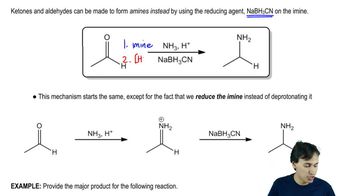
Reductive Amination

Aldehydes and Ketones

Aldehydes and ketones are two classes of carbonyl compounds. Aldehydes, such as 2-methylpropanal, have the carbonyl group (C=O) at the end of the carbon chain, while ketones, like cyclohexanone, have it within the chain. Understanding their structure is crucial for predicting the products of reduction reactions, as the position of the carbonyl group influences the resulting alcohol's structure.
Recommended video:
Guided course
03:57
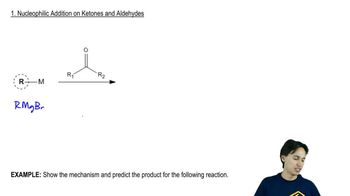
Nucleophilic Addition on Ketones and Aldehydes

Sodium Borohydride as a Reducing Agent

Sodium borohydride is a selective and mild reducing agent commonly used in organic synthesis. It effectively reduces aldehydes and ketones to their corresponding alcohols without affecting other functional groups. Its mechanism involves the transfer of a hydride ion (H-) to the carbonyl carbon, leading to the formation of an alcohol, which is essential for understanding the products of the given reduction reactions.
Recommended video:
Guided course
09:28
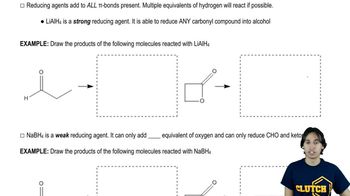
Reducing Agents