Ch. 16 - Reactions of Aldehydes and Ketones • More Reactions of Carboxylic Acid Derivatives
Bruice - Organic Chemistry 8th Edition
Bruice8th EditionOrganic ChemistryISBN: 9780135213711Not the one you use?Change textbook
Chapter 17, Problem 78b

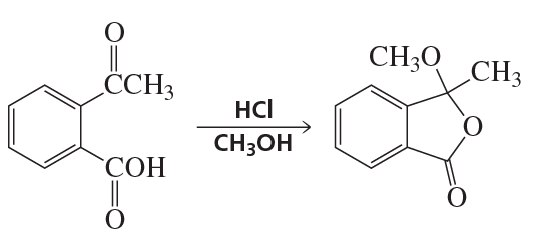
Propose a mechanism for each of the following reactions:
b. Chemical reaction diagram showing the conversion of a carboxylic acid to a lactone using HCl in methanol.

Verified step by step guidance
1
Step 1: Analyze the reactants and conditions. The starting material is a compound containing both a carboxylic acid group and an aldehyde group attached to a benzene ring. The reaction conditions include methanol (CH₃OH) and an acidic catalyst (H₃O⁺), which suggests esterification and/or acetal formation may occur.
Step 2: Protonation of the carbonyl oxygen. Under acidic conditions, the aldehyde group is protonated by H₃O⁺, increasing the electrophilicity of the carbonyl carbon and making it more susceptible to nucleophilic attack.
Step 3: Nucleophilic attack by methanol. Methanol acts as a nucleophile and attacks the protonated aldehyde carbonyl carbon, forming a tetrahedral intermediate.
Step 4: Formation of the hemiacetal intermediate. The tetrahedral intermediate undergoes proton transfer, leading to the formation of a hemiacetal (an alcohol and ether group attached to the same carbon).
Step 5: Further reaction to form the acetal. Under acidic conditions and excess methanol, the hemiacetal can react further to form the acetal, where two ether groups are attached to the same carbon. This involves the loss of water and stabilization of the acetal product.

Verified video answer for a similar problem:

This video solution was recommended by our tutors as helpful for the problem above.
Video duration:
6m
Was this helpful?

Key Concepts

Here are the essential concepts you must grasp in order to answer the question correctly.

Carboxylic Acid Derivatives

Carboxylic acid derivatives include compounds like esters, amides, and anhydrides, which are derived from carboxylic acids. They retain the carbonyl (C=O) group and can undergo nucleophilic acyl substitution reactions. Understanding these derivatives is crucial for predicting reaction mechanisms, as they often react with nucleophiles to form new products.
Recommended video:
Guided course
03:50
Intro to Carboxylic Acid Derivatives

Nucleophilic Acyl Substitution

Nucleophilic acyl substitution is a fundamental reaction mechanism in organic chemistry where a nucleophile attacks the electrophilic carbon of a carbonyl group, leading to the substitution of a leaving group. This mechanism is key in reactions involving carboxylic acid derivatives, where the nucleophile replaces the leaving group, resulting in the formation of a new compound.
Recommended video:
Guided course
01:47
Nucleophiles and Electrophiles can react in Substitution Reactions.

Protonation and Acid Catalysis

Protonation is the addition of a proton (H+) to a molecule, which can enhance the electrophilicity of a carbonyl carbon in carboxylic acid derivatives. Acid catalysis, often using H3O+, facilitates reactions by stabilizing intermediates and making the carbonyl more reactive towards nucleophiles. This concept is essential for understanding how reactions proceed under acidic conditions.
Recommended video:
2:50
Acid-Base Catalysis Concept 3