Ch. 16 - Reactions of Aldehydes and Ketones • More Reactions of Carboxylic Acid Derivatives
Bruice - Organic Chemistry 8th Edition
Bruice8th EditionOrganic ChemistryISBN: 9780135213711Not the one you use?Change textbook
Chapter 17, Problem 57a(8)

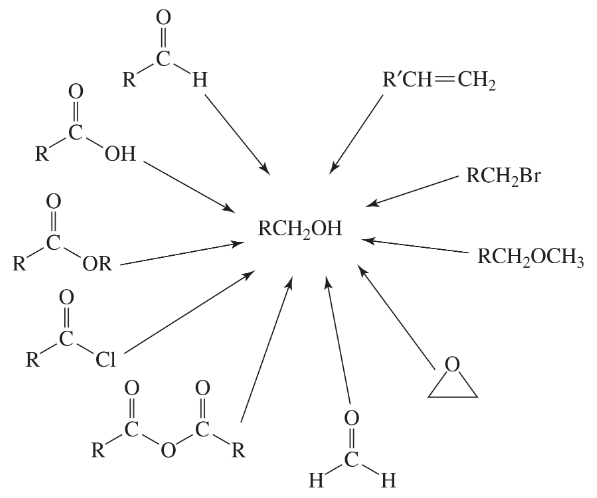
a. Show the reagents required to form the primary alcohol in each of the following reactions.

Verified step by step guidance
1
Step 1: Analyze the reaction. The starting material is an ether (CH3CH2OCH2CH3), and the products are a primary alcohol (CH3CH2OH) and an alkyl iodide (CH3CH2I). This suggests a cleavage of the ether bond.
Step 2: Recognize the type of reaction. Ether cleavage typically occurs under acidic conditions with a strong nucleophile. In this case, the nucleophile is iodide (I⁻), which comes from HI (hydroiodic acid).
Step 3: Identify the reagents. The reagent required for this reaction is concentrated hydroiodic acid (HI), which provides both the acidic environment and the iodide nucleophile.
Step 4: Describe the mechanism. The ether undergoes protonation by HI, making the oxygen more electrophilic. This facilitates the cleavage of the C-O bond, forming the primary alcohol and alkyl iodide.
Step 5: Note the regioselectivity. In this reaction, the cleavage occurs to produce the more stable carbocation intermediate, ensuring the formation of the primary alcohol and alkyl iodide as products.

Verified video answer for a similar problem:

This video solution was recommended by our tutors as helpful for the problem above.
Video duration:
3m
Was this helpful?

Key Concepts

Here are the essential concepts you must grasp in order to answer the question correctly.

Ether Cleavage

Ether cleavage is a reaction where an ether is broken down into two alcohols or an alcohol and an alkyl halide. This process typically requires strong acids, such as HI or HBr, which protonate the ether oxygen, making it more susceptible to nucleophilic attack. The cleavage results in the formation of a primary alcohol and an alkyl halide, as shown in the provided reaction.
Recommended video:
1:45
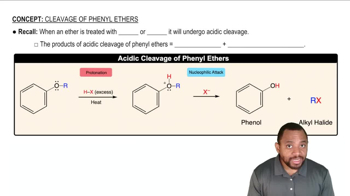
Cleavage of Phenyl Ethers Concept 1

Primary Alcohol Formation

A primary alcohol is characterized by having the hydroxyl (-OH) group attached to a carbon atom that is bonded to only one other carbon atom. In the context of ether cleavage, the reaction conditions and the choice of reagents are crucial for ensuring that the resulting alcohol is primary. This is important for understanding the selectivity of the reaction and the stability of the intermediates formed during the process.
Recommended video:
1:11
Primary Protein Structure Example 1

Reagents for Ether Cleavage

The choice of reagents is essential for ether cleavage reactions. Common reagents include hydroiodic acid (HI) and hydrobromic acid (HBr), which provide the necessary protons to initiate the cleavage. These reagents not only facilitate the breaking of the ether bond but also help in the formation of the primary alcohol and the corresponding alkyl halide, as depicted in the reaction diagram.
Recommended video:
1:45
Cleavage of Phenyl Ethers Concept 1