Ch. 15 - Reactions of Carboxylic Acids and Carboxylic Acid Derivatives
Bruice - Organic Chemistry 8th Edition
Bruice8th EditionOrganic ChemistryISBN: 9780135213711Not the one you use?Change textbook
Chapter 16, Problem 6

Which is a correct statement?
A. The delocalization energy of an ester is about 18 kcal/mol, and the delocalization energy of an amide is about 10 kcal/mol.
B. The delocalization energy of an ester is about 10 kcal/mol, and the delocalization energy of an amide is about 18 kcal/mol.

Verified step by step guidance
1
Understand the concept of delocalization energy: Delocalization energy refers to the stabilization energy gained when electrons are delocalized over a conjugated system. In organic molecules like esters and amides, this delocalization occurs due to resonance structures.
Analyze the resonance in esters: In esters, the lone pair of electrons on the oxygen atom can delocalize into the carbonyl group, creating resonance structures. However, the delocalization is limited because the oxygen atom is highly electronegative and less willing to share its lone pair.
Analyze the resonance in amides: In amides, the lone pair of electrons on the nitrogen atom can delocalize into the carbonyl group. Nitrogen is less electronegative than oxygen, making it more willing to share its lone pair, resulting in stronger resonance and greater delocalization energy compared to esters.
Compare the delocalization energies: Since the resonance in amides is stronger than in esters, the delocalization energy of an amide is higher (approximately 18 kcal/mol), while the delocalization energy of an ester is lower (approximately 10 kcal/mol).
Conclude the correct statement: Based on the analysis, the correct statement is B: 'The delocalization energy of an ester is about 10 kcal/mol, and the delocalization energy of an amide is about 18 kcal/mol.'

Verified video answer for a similar problem:

This video solution was recommended by our tutors as helpful for the problem above.
Video duration:
9m
Was this helpful?

Key Concepts

Here are the essential concepts you must grasp in order to answer the question correctly.

Delocalization Energy

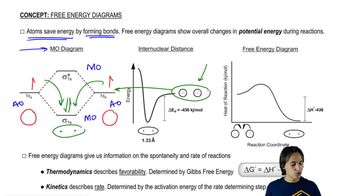
Delocalization energy refers to the stabilization that occurs when electrons are spread out over several atoms rather than being localized between two. This phenomenon is particularly significant in resonance structures, where the actual structure of a molecule is a hybrid of multiple forms. In organic compounds, delocalization can influence reactivity and stability, making it a crucial concept in understanding molecular behavior.
Recommended video:
Guided course
06:07
Introduction to free energy diagrams.

Ester and Amide Structures

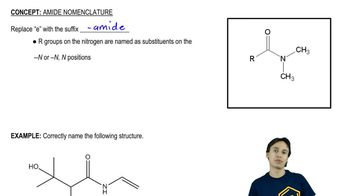
Esters and amides are both functional groups derived from carboxylic acids, but they have distinct structures and properties. Esters are formed from the reaction of an alcohol and a carboxylic acid, characterized by the -COO- group, while amides result from the reaction of an amine with a carboxylic acid, featuring the -CONH2 group. Understanding their structures helps in analyzing their stability and reactivity, particularly in relation to delocalization energy.
Recommended video:
Guided course
01:33
Amide Nomenclature

Comparative Stability

Comparative stability in organic chemistry often involves evaluating the energy associated with different functional groups. In the context of esters and amides, the delocalization energy can indicate which compound is more stable. Generally, amides exhibit greater delocalization due to resonance involving the nitrogen atom, leading to a higher stabilization energy compared to esters, which is essential for answering questions about their relative energies.
Recommended video:
Guided course
03:43
The radical stability trend.