What reagent should be used to carry out the following reaction?
Ch. 15 - Reactions of Carboxylic Acids and Carboxylic Acid Derivatives
All textbooks
Bruice 8th Edition
Ch. 15 - Reactions of Carboxylic Acids and Carboxylic Acid Derivatives
Problem 8b
Bruice 8th Edition
Ch. 15 - Reactions of Carboxylic Acids and Carboxylic Acid Derivatives
Problem 8bChapter 16, Problem 8b
What is the product of an acyl substitution reaction—a new carboxylic acid derivative, a mixture of two carboxylic acid derivatives, or no reaction—if the new group in the tetrahedral intermediate is the following? b. a weaker base than the substituent that is attached to the acyl group
Verified step by step guidance1
Identify the type of reaction: An acyl substitution reaction involves the replacement of the leaving group attached to the acyl carbon with a nucleophile. The reaction proceeds through a tetrahedral intermediate.
Analyze the leaving group: The stability of the leaving group is determined by its basicity. A weaker base (more stable) is a better leaving group compared to a stronger base (less stable).
Compare the basicity of the new group and the existing substituent: If the new group in the tetrahedral intermediate is a weaker base than the substituent currently attached to the acyl group, it will be more likely to leave during the collapse of the intermediate.
Predict the outcome: Since the new group is a weaker base, it will not replace the existing substituent. Instead, the tetrahedral intermediate will collapse back to the original acyl compound, resulting in no reaction.
Conclude the result: The reaction will not produce a new carboxylic acid derivative or a mixture of derivatives. The starting material remains unchanged because the weaker base cannot displace the stronger base.

Verified video answer for a similar problem:
This video solution was recommended by our tutors as helpful for the problem above.
Video duration:
5mWas this helpful?
Key Concepts
Here are the essential concepts you must grasp in order to answer the question correctly.
Acyl Substitution Reaction
An acyl substitution reaction involves the replacement of a leaving group in an acyl compound (like an acyl chloride or an anhydride) with a nucleophile. This process typically results in the formation of a new carboxylic acid derivative. Understanding the mechanism of this reaction is crucial, as it helps predict the outcome based on the nature of the nucleophile and the leaving group.
Recommended video:
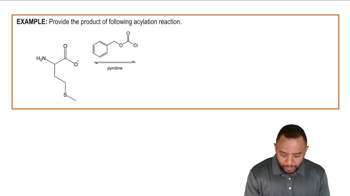
Reactions of Amino Acids: Acylation Example 1
Tetrahedral Intermediate
During acyl substitution, a tetrahedral intermediate is formed when the nucleophile attacks the carbonyl carbon of the acyl compound. This intermediate is crucial for determining the fate of the reaction, as it can either collapse back to the starting materials or proceed to form the final product, depending on the stability of the new group attached and the nature of the leaving group.
Recommended video:
Guided course
Stability of Conjugated Intermediates
Strength of Bases
The strength of the nucleophile (or new group) in the tetrahedral intermediate plays a significant role in the outcome of the acyl substitution reaction. If the new group is a weaker base than the original substituent, it is less likely to displace the leaving group effectively, which can lead to no reaction or the formation of a mixture of products. This concept is essential for predicting the reactivity and selectivity of the reaction.
Recommended video:
Base Pairing Concept 1
Related Practice
Textbook Question
2
views
Textbook Question
b. What is the product of the reaction of acetamide with HO−? The pKa of NH3 is 36; the pKa of H2O is 15.7.
1
views
Textbook Question
Using the pKa values listed in [TABLE 15.1], predict the products of the following reactions:
d.
1
views
Textbook Question
What is the product of an acyl substitution reaction—a new carboxylic acid derivative, a mixture of two carboxylic acid derivatives, or no reaction—if the new group in the tetrahedral intermediate is the following? a. a stronger base than the substituent that is attached to the acyl group
2
views
Textbook Question
Starting with acetyl chloride, what neutral nucleophile would you use to synthesize each of the following compounds?
c.
2
views
Textbook Question
Using the pKa values listed in [TABLE 15.1], predict the products of the following reactions:
c.
1
views