Ch. 15 - Reactions of Carboxylic Acids and Carboxylic Acid Derivatives
Bruice - Organic Chemistry 8th Edition
Bruice8th EditionOrganic ChemistryISBN: 9780135213711Not the one you use?Change textbook
Chapter 16, Problem 68a,b

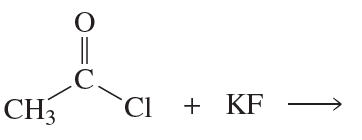
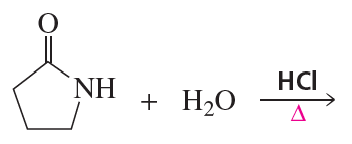
What are the products of the following reactions?
a. Chemical reaction showing acyl chloride and potassium fluoride as reactants, leading to nucleophilic acyl substitution.
b. Chemical reaction diagram showing a cyclic compound with NH and O reacting with water and HCl, indicating nucleophilic acyl substitution.

Verified step by step guidance
1
Step 1: For reaction (i), identify the reactants. The starting compound is an acyl chloride (CH3C=O(Cl)), and the reagent is NaF. Acyl chlorides are reactive and can undergo substitution reactions where the chloride group is replaced by another nucleophile.
Step 2: Recognize the role of NaF in reaction (i). Fluoride ion (F-) acts as a nucleophile and replaces the chloride ion (Cl-) in the acyl chloride. This substitution results in the formation of an acyl fluoride (CH3C=O(F)).
Step 3: For reaction (ii), identify the reactants. The starting compound is an amide (CH3C=O(NHCH2CH3)), and the reagents are NaOH, H2O, and heat. Amides can undergo hydrolysis under basic conditions to yield carboxylic acids or their salts.
Step 4: Recognize the mechanism of hydrolysis in reaction (ii). Under basic conditions, the amide bond is broken, and the nitrogen group is removed as ammonia (NH3) or an amine. The remaining carbonyl group forms a carboxylate ion (CH3COO-) due to the presence of NaOH.
Step 5: Summarize the products. For reaction (i), the product is acyl fluoride (CH3C=O(F)). For reaction (ii), the products are sodium acetate (CH3COO-Na+) and ethylamine (CH3CH2NH2).

Verified video answer for a similar problem:

This video solution was recommended by our tutors as helpful for the problem above.
Video duration:
2m
Was this helpful?

Key Concepts

Here are the essential concepts you must grasp in order to answer the question correctly.

Nucleophilic Acyl Substitution

Nucleophilic acyl substitution is a fundamental reaction in organic chemistry where a nucleophile attacks the carbonyl carbon of an acyl compound, leading to the replacement of a leaving group (like Cl) with the nucleophile. This reaction is crucial for understanding how acyl chlorides react with nucleophiles, such as fluoride ions in the presence of NaF, resulting in the formation of a new product.
Recommended video:
Guided course
01:47
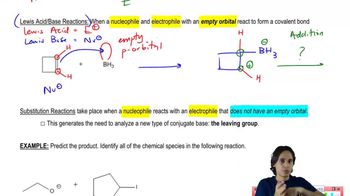
Nucleophiles and Electrophiles can react in Substitution Reactions.

Role of Nucleophiles

Nucleophiles are species that donate an electron pair to form a chemical bond in a reaction. In the context of the provided reactions, fluoride ions (from KF) and hydroxide ions (from NaOH) act as nucleophiles that attack the electrophilic carbonyl carbon, facilitating the substitution process. Understanding the nature and strength of nucleophiles is essential for predicting the outcome of these reactions.
Recommended video:
Guided course
08:27
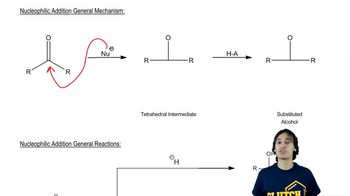
Nucleophilic Addition

Hydrolysis of Amides

The hydrolysis of amides involves the reaction of an amide with water, often in the presence of an acid or base, leading to the formation of a carboxylic acid and an amine or ammonia. In the second reaction, heating an amide with NaOH and water promotes hydrolysis, which is important for understanding how amides can be converted into more reactive carboxylic acids and amines under specific conditions.
Recommended video:
Guided course
01:33
Amide Nomenclature