Ch. 15 - Reactions of Carboxylic Acids and Carboxylic Acid Derivatives
Bruice - Organic Chemistry 8th Edition
Bruice8th EditionOrganic ChemistryISBN: 9780135213711Not the one you use?Change textbook
Chapter 16, Problem 12d

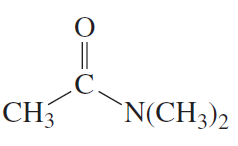
Starting with acetyl chloride, what neutral nucleophile would you use to synthesize each of the following compounds?
d. Chemical structure of N,N-dimethylacetamide, featuring a carbonyl group attached to a methyl and a dimethylamino group.

Verified step by step guidance
1
Step 1: Analyze the target compound structure. The compound is an amide with an ethyl group attached to the nitrogen atom and a propyl group attached to the carbonyl carbon.
Step 2: Recall the reactivity of acetyl chloride. Acetyl chloride is an acyl halide, which reacts readily with nucleophiles to form amides, esters, or other derivatives.
Step 3: Identify the neutral nucleophile required to form the amide. To synthesize the given compound, the nucleophile must be diethylamine (NH(CH2CH3)2), as it provides the ethyl groups attached to the nitrogen atom.
Step 4: Write the reaction mechanism. Acetyl chloride reacts with diethylamine in a nucleophilic acyl substitution reaction. The lone pair on the nitrogen of diethylamine attacks the carbonyl carbon of acetyl chloride, displacing the chloride ion.
Step 5: Consider reaction conditions. The reaction typically occurs in the presence of a base (e.g., pyridine) to neutralize the HCl byproduct and ensure the reaction proceeds efficiently.

Verified video answer for a similar problem:

This video solution was recommended by our tutors as helpful for the problem above.
Video duration:
3m
Was this helpful?

Key Concepts

Here are the essential concepts you must grasp in order to answer the question correctly.

Acetyl Chloride Reactivity

Acetyl chloride is a reactive acyl chloride that can undergo nucleophilic acyl substitution. In this reaction, the carbonyl carbon of acetyl chloride is electrophilic, making it susceptible to attack by nucleophiles. Understanding this reactivity is crucial for predicting the products formed when acetyl chloride reacts with various nucleophiles.
Recommended video:
Guided course
01:36
Synthesis of Acid Chlorides

Nucleophiles

Nucleophiles are species that donate an electron pair to form a chemical bond in a reaction. In the context of synthesizing amides from acetyl chloride, neutral nucleophiles such as amines can attack the electrophilic carbonyl carbon. The choice of nucleophile affects the structure and properties of the resulting amide compound.
Recommended video:
Guided course
08:27
Nucleophilic Addition

Amide Formation

Amides are formed when a carboxylic acid derivative, like acetyl chloride, reacts with an amine. This reaction involves the nucleophilic attack of the amine on the carbonyl carbon, followed by the elimination of a leaving group (in this case, chloride). Understanding the mechanism of amide formation is essential for predicting the outcome of the reaction and the structure of the final product.
Recommended video:
Guided course
01:33
Amide Nomenclature