Ch. 15 - Reactions of Carboxylic Acids and Carboxylic Acid Derivatives
Bruice - Organic Chemistry 8th Edition
Bruice8th EditionOrganic ChemistryISBN: 9780135213711Not the one you use?Change textbook
Chapter 16, Problem 85a

Show how the following compounds could be prepared from the given starting materials. You can use any necessary organic or inorganic reagents.
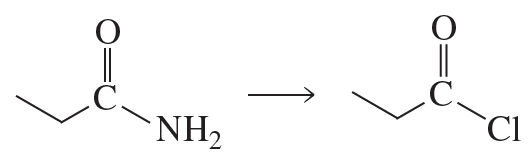
a. Chemical reaction diagram showing the conversion of an amide to an acyl chloride with structural formulas.

Verified step by step guidance
1
Step 1: Identify the functional group transformation. The starting material is an amide (CH3CH2(C=O)NH2), and the target compound is an acyl chloride (CH3CH2(C=O)Cl). This transformation involves replacing the -NH2 group with a -Cl group.
Step 2: Recognize the reagent required for this transformation. Amides can be converted to acyl chlorides using reagents such as thionyl chloride (SOCl2) or phosphorus pentachloride (PCl5). These reagents facilitate the substitution of the amide group with a chlorine atom.
Step 3: Write the reaction mechanism. When thionyl chloride (SOCl2) is used, the amide reacts with SOCl2 to form an intermediate, which then eliminates sulfur dioxide (SO2) and hydrogen chloride (HCl) to yield the acyl chloride.
Step 4: Ensure proper reaction conditions. The reaction typically occurs under mild heating to ensure the complete conversion of the amide to the acyl chloride.
Step 5: Verify the product structure. After the reaction, the product should have the desired acyl chloride functional group (CH3CH2(C=O)Cl), replacing the original amide group.

Verified video answer for a similar problem:

This video solution was recommended by our tutors as helpful for the problem above.
Video duration:
2m
Was this helpful?

Key Concepts

Here are the essential concepts you must grasp in order to answer the question correctly.

Amides and Their Reactivity

Amides are organic compounds characterized by a carbonyl group (C=O) attached to a nitrogen atom (N). They can undergo various reactions, including hydrolysis and conversion to acyl chlorides. Understanding the reactivity of amides is crucial for predicting their transformation into other functional groups, such as acyl chlorides, which are more reactive and useful in further synthetic applications.
Recommended video:
Guided course
01:33
Amide Nomenclature

Acyl Chloride Formation

Acyl chlorides are derived from carboxylic acids by replacing the hydroxyl group (-OH) with a chlorine atom (-Cl). This transformation can be achieved through the reaction of an amide with reagents like thionyl chloride (SOCl2) or oxalyl chloride (COCl)2. Recognizing the conditions and reagents necessary for this conversion is essential for successfully synthesizing acyl chlorides from amides.
Recommended video:
Guided course
01:57
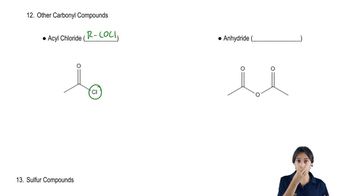
Recognizing acyl chlorides and anhydrides.

Reagents in Organic Synthesis

In organic synthesis, various reagents are employed to facilitate chemical transformations. For the conversion of amides to acyl chlorides, reagents such as thionyl chloride or phosphorus pentachloride are commonly used. Understanding the role of these reagents, including their mechanisms and the conditions under which they operate, is vital for designing effective synthetic pathways in organic chemistry.
Recommended video:
1:16
Synthesis of Amino Acids: Strecker Synthesis Example 1