Ch. 15 - Reactions of Carboxylic Acids and Carboxylic Acid Derivatives
Bruice - Organic Chemistry 8th Edition
Bruice8th EditionOrganic ChemistryISBN: 9780135213711Not the one you use?Change textbook
Chapter 16, Problem 48d

Draw a structure for each of the following:
d. propanenitrile

Verified step by step guidance
1
Step 1: Understand the name 'propanenitrile'. The prefix 'propane' indicates a three-carbon chain, and the suffix 'nitrile' indicates the presence of a cyano group (-C≡N) attached to the chain.
Step 2: Begin by drawing a straight chain of three carbon atoms. Label them as C1, C2, and C3 for clarity.
Step 3: Attach the nitrile group (-C≡N) to the first carbon atom (C1). This is because the nitrile group is typically placed at the end of the chain unless specified otherwise.
Step 4: Complete the structure by adding hydrogen atoms to the remaining carbon atoms (C2 and C3) to satisfy the valency of carbon (which is 4). Ensure that each carbon atom has the correct number of bonds.
Step 5: Verify the structure to ensure it matches the molecular formula C3H5N, which corresponds to propanenitrile. Double-check the placement of the nitrile group and the hydrogens.

Verified video answer for a similar problem:

This video solution was recommended by our tutors as helpful for the problem above.
Video duration:
2m
Was this helpful?

Key Concepts

Here are the essential concepts you must grasp in order to answer the question correctly.

Nitriles

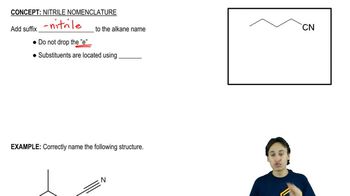
Nitriles are organic compounds that contain a cyano group (-C≡N), which consists of a carbon atom triple-bonded to a nitrogen atom. They are derived from carboxylic acids by replacing the -OH group with a -CN group. Nitriles are important in organic synthesis and can be converted into various functional groups, including amines and carboxylic acids.
Recommended video:
Guided course
01:01
Nitrile Nomenclature

Aliphatic Compounds

Aliphatic compounds are organic molecules that consist of carbon and hydrogen arranged in straight or branched chains, or in non-aromatic rings. Propanenitrile, specifically, is an aliphatic nitrile, meaning it has a linear structure with a cyano group attached to a three-carbon chain. Understanding the structure of aliphatic compounds is essential for drawing and interpreting their chemical structures.
Recommended video:
Guided course
01:40
Defining meso compounds.

IUPAC Nomenclature

IUPAC nomenclature is a systematic method for naming organic chemical compounds. It provides rules for naming compounds based on their structure, functional groups, and the longest carbon chain. For propanenitrile, the name indicates a three-carbon chain (propane) with a nitrile functional group, which is crucial for accurately representing its structure in chemical drawings.
Recommended video:
Guided course
03:43
The different parts of an IUPAC name