Ch. 15 - Reactions of Carboxylic Acids and Carboxylic Acid Derivatives
Bruice - Organic Chemistry 8th Edition
Bruice8th EditionOrganic ChemistryISBN: 9780135213711Not the one you use?Change textbook
Chapter 16, Problem 46a

Propose a mechanism for the formation of succinic anhydride from succinic acid in the presence of acetic anhydride at neutral pH.

Verified step by step guidance
1
Identify the functional groups in succinic acid and acetic anhydride. Succinic acid contains two carboxylic acid groups (-COOH), while acetic anhydride is a reactive anhydride that can act as an acylating agent.
Recognize the role of acetic anhydride in the reaction. Acetic anhydride reacts with one of the carboxylic acid groups of succinic acid to form an intermediate mixed anhydride. This step involves nucleophilic attack by the carboxylate oxygen of succinic acid on the carbonyl carbon of acetic anhydride, followed by the departure of an acetate ion.
Propose the cyclization step. The second carboxylic acid group of succinic acid acts as a nucleophile, attacking the carbonyl carbon of the mixed anhydride intermediate. This intramolecular nucleophilic acyl substitution leads to the formation of a five-membered ring structure, which is succinic anhydride.
Account for the neutral pH condition. At neutral pH, the reaction proceeds without the need for additional acid or base catalysts because acetic anhydride is sufficiently reactive to facilitate the formation of the mixed anhydride and subsequent cyclization.
Conclude the mechanism by noting the byproduct. The reaction releases acetic acid as a byproduct when the acetate ion from acetic anhydride combines with a proton from the reaction intermediates.

Verified video answer for a similar problem:

This video solution was recommended by our tutors as helpful for the problem above.
Video duration:
7m
Was this helpful?

Key Concepts

Here are the essential concepts you must grasp in order to answer the question correctly.

Carboxylic Acids and Anhydrides

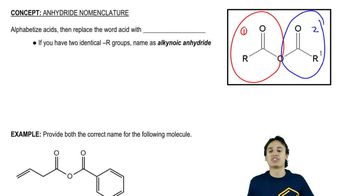
Carboxylic acids, like succinic acid, contain a carboxyl group (-COOH) that can undergo dehydration to form an anhydride. Anhydrides are formed when two carboxylic acid molecules lose a water molecule, resulting in a compound with two acyl groups. Understanding the structure and reactivity of these functional groups is essential for proposing a mechanism for the transformation.
Recommended video:
Guided course
03:35
Anhydride Nomenclature

Nucleophilic Acyl Substitution

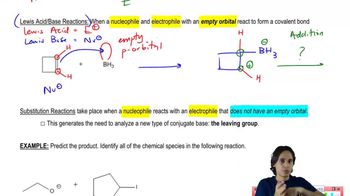
Nucleophilic acyl substitution is a fundamental reaction mechanism in organic chemistry where a nucleophile attacks the carbonyl carbon of an acyl compound, leading to the substitution of a leaving group. In the case of succinic acid and acetic anhydride, the hydroxyl group of succinic acid can be replaced by an acetic group, facilitating the formation of succinic anhydride. This concept is crucial for understanding how the reaction proceeds.
Recommended video:
Guided course
01:47
Nucleophiles and Electrophiles can react in Substitution Reactions.

Dehydration Reactions

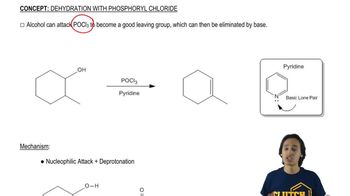
Dehydration reactions involve the removal of water from a molecule, often leading to the formation of a double bond or a cyclic structure. In the context of succinic acid and acetic anhydride, the dehydration step is key to forming succinic anhydride, as it involves the elimination of water during the reaction. Recognizing the role of dehydration in organic transformations is vital for grasping the proposed mechanism.
Recommended video:
Guided course
01:23
General Reaction of Dehydration with POCl3