Ch. 14 - NMR Spectroscopy
Bruice - Organic Chemistry 8th Edition
Bruice8th EditionOrganic ChemistryISBN: 9780135213711Not the one you use?Change textbook
Chapter 15, Problem 77b

Identify each of the following compounds from its molecular formula and its IR and 1H NMR spectra:
b.C6H14O
<IMAGE>

Verified step by step guidance
1
Step 1: Analyze the molecular formula (C6H14O). The formula indicates the compound contains 6 carbons, 14 hydrogens, and 1 oxygen. Calculate the degree of unsaturation using the formula: \( \text{Degree of Unsaturation} = rac{2C + 2 - H + N - X}{2} \), where \( C \) is the number of carbons, \( H \) is the number of hydrogens, \( N \) is the number of nitrogens, and \( X \) is the number of halogens. For C6H14O, the degree of unsaturation is 0, meaning the compound is fully saturated (no double bonds, triple bonds, or rings).
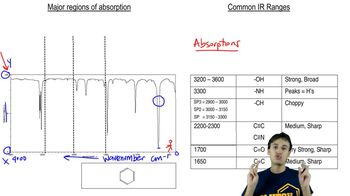
Step 2: Examine the IR spectrum. Look for characteristic absorption bands that indicate the presence of functional groups. For example, a broad peak around 3200-3600 cm⁻¹ suggests the presence of an -OH group (alcohol). If no such peak is observed, the oxygen might be part of an ether group.
Step 3: Analyze the 1H NMR spectrum. Look for the number of signals, their chemical shifts, splitting patterns, and integration values. For example, a signal around 3.3-4.0 ppm could indicate protons adjacent to an oxygen atom (e.g., in an alcohol or ether). The splitting patterns (singlet, doublet, triplet, etc.) provide information about the number of neighboring hydrogens, and the integration values indicate the relative number of hydrogens contributing to each signal.
Step 4: Combine the information from the IR and 1H NMR spectra. If the IR spectrum shows an -OH group and the NMR spectrum has a singlet corresponding to a hydroxyl proton (around 1-5 ppm), the compound is likely an alcohol. If the IR spectrum lacks an -OH peak and the NMR spectrum shows signals consistent with an ether, the compound is likely an ether.
Step 5: Propose a structure for the compound based on the molecular formula, degree of unsaturation, and spectral data. For example, if the IR spectrum shows an -OH group and the NMR spectrum indicates a simple alcohol structure, the compound could be a hexanol isomer. If the IR spectrum suggests an ether and the NMR spectrum supports this, the compound could be a hexyl ether isomer. Verify the proposed structure by ensuring it matches all spectral data.

Verified video answer for a similar problem:

This video solution was recommended by our tutors as helpful for the problem above.
Video duration:
6m
Was this helpful?

Key Concepts

Here are the essential concepts you must grasp in order to answer the question correctly.

Molecular Formula Interpretation

The molecular formula provides essential information about the number and types of atoms in a compound. For C6H14O, it indicates the presence of six carbon atoms, fourteen hydrogen atoms, and one oxygen atom. Understanding how to interpret this formula helps in predicting the possible structures and functional groups present in the compound.
Recommended video:
Guided course
06:06
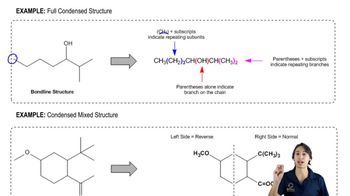
How to interpret condensed structures.

Infrared (IR) Spectroscopy

IR spectroscopy is a technique used to identify functional groups in a molecule based on the absorption of infrared light. Different bonds absorb characteristic wavelengths, allowing for the identification of functional groups such as alcohols, ethers, and alkanes. Analyzing the IR spectrum of C6H14O will reveal specific peaks that correspond to the O-H stretch of alcohols, aiding in compound identification.
Recommended video:
Guided course
16:04
General Features of IR Spect

Proton Nuclear Magnetic Resonance (1H NMR) Spectroscopy

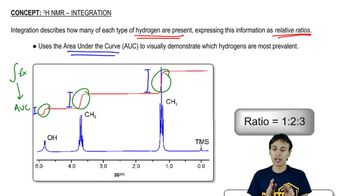
1H NMR spectroscopy provides information about the hydrogen atoms in a molecule, including their environment and connectivity. The chemical shifts, splitting patterns, and integration of peaks in the NMR spectrum can reveal the number of hydrogen atoms in different environments, helping to deduce the structure of C6H14O. This technique is crucial for confirming the identity of the compound based on its unique spectral characteristics.
Recommended video:
Guided course
06:46
1H NMR Integration