Ch. 14 - NMR Spectroscopy
Bruice - Organic Chemistry 8th Edition
Bruice8th EditionOrganic ChemistryISBN: 9780135213711Not the one you use?Change textbook
Chapter 15, Problem 51g

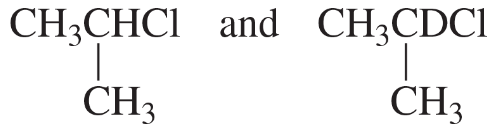
How can 1H NMR distinguish between the compounds in each of the following pairs?
g.

Verified step by step guidance
1
Step 1: Analyze the chemical structures of the two compounds. The first compound contains only hydrogen atoms bonded to the carbons, while the second compound has one deuterium (D) atom replacing a hydrogen atom on the second carbon.
Step 2: Understand the principle of 1H NMR spectroscopy. 1H NMR detects signals from hydrogen nuclei (protons). Deuterium (D) does not produce a signal in 1H NMR because it is not a proton; it is a heavier isotope of hydrogen.
Step 3: Predict the 1H NMR spectra for each compound. In the first compound, all hydrogens will contribute to the NMR signals, resulting in a specific pattern of chemical shifts and splitting based on the environment of each hydrogen. In the second compound, the absence of a proton (due to the presence of deuterium) will alter the splitting pattern and potentially the chemical shift of nearby hydrogens.
Step 4: Focus on the splitting patterns. In the first compound, the hydrogens on the second carbon will split the signals of adjacent hydrogens based on the n+1 rule. In the second compound, the deuterium will not split the signals, leading to a different splitting pattern for the hydrogens on adjacent carbons.
Step 5: Compare the spectra of the two compounds. The presence of deuterium in the second compound will result in fewer peaks or altered splitting patterns in the 1H NMR spectrum compared to the first compound, allowing for differentiation between the two.

Verified video answer for a similar problem:

This video solution was recommended by our tutors as helpful for the problem above.
Video duration:
2m
Was this helpful?

Key Concepts

Here are the essential concepts you must grasp in order to answer the question correctly.

1H NMR Spectroscopy

Proton Nuclear Magnetic Resonance (1H NMR) spectroscopy is a powerful analytical technique used to determine the structure of organic compounds. It works by measuring the magnetic environment of hydrogen atoms in a molecule, providing information about the number of hydrogen atoms, their chemical environment, and connectivity. Different chemical environments result in distinct resonance signals, allowing for the differentiation of compounds.
Recommended video:
Guided course
06:46
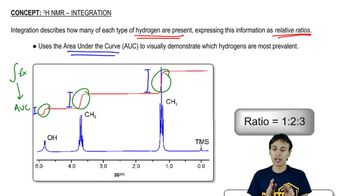
1H NMR Integration

Chemical Shift

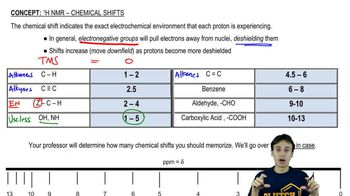
Chemical shift refers to the position of a signal in the NMR spectrum, which is influenced by the electronic environment surrounding the hydrogen atoms. It is measured in parts per million (ppm) and varies based on factors such as electronegativity of nearby atoms and hybridization. In the provided compounds, the presence of deuterium (D) instead of hydrogen (H) alters the chemical shift, enabling 1H NMR to distinguish between the two structures.
Recommended video:
Guided course
11:44
1H NMR Chemical Shifts

Integration and Multiplicity

Integration in 1H NMR refers to the area under the peaks in the spectrum, which correlates to the number of hydrogen atoms contributing to that signal. Multiplicity indicates the splitting pattern of the signals, which arises from neighboring hydrogen atoms (n+1 rule). These features help identify the number of hydrogen atoms in different environments and their interactions, providing further insight into the structural differences between the compounds.
Recommended video:
Guided course
06:46
1H NMR Integration