Ch. 14 - NMR Spectroscopy
Bruice - Organic Chemistry 8th Edition
Bruice8th EditionOrganic ChemistryISBN: 9780135213711Not the one you use?Change textbook
Chapter 15, Problem 43a

How can 1,2-, 1,3-, and 1,4-dinitrobenzene be distinguished by
a. 1H NMR spectroscopy?

Verified step by step guidance
1
Understand the problem: The goal is to distinguish between 1,2-dinitrobenzene (ortho), 1,3-dinitrobenzene (meta), and 1,4-dinitrobenzene (para) using 1H NMR spectroscopy. The key lies in analyzing the symmetry and chemical environment of the aromatic protons in each compound.
Step 1: Analyze the structure of 1,2-dinitrobenzene (ortho). In this compound, the two nitro groups are adjacent to each other. This creates a lack of symmetry in the molecule, resulting in four distinct aromatic proton environments. In the 1H NMR spectrum, you would expect four signals with different chemical shifts due to the unique environments of the protons.
Step 2: Analyze the structure of 1,3-dinitrobenzene (meta). Here, the nitro groups are separated by one carbon atom. This arrangement introduces a plane of symmetry in the molecule, leading to three distinct aromatic proton environments. In the 1H NMR spectrum, you would observe three signals corresponding to these environments.
Step 3: Analyze the structure of 1,4-dinitrobenzene (para). In this compound, the nitro groups are directly opposite each other on the benzene ring. This high degree of symmetry results in only two distinct aromatic proton environments. In the 1H NMR spectrum, you would see two signals due to the equivalent protons on either side of the nitro groups.
Step 4: Compare the spectra. By analyzing the number of signals and their splitting patterns in the 1H NMR spectra of the three compounds, you can distinguish between 1,2-, 1,3-, and 1,4-dinitrobenzene. The key differences are the number of distinct proton environments (four for ortho, three for meta, and two for para) and the chemical shifts influenced by the electron-withdrawing nitro groups.

Verified video answer for a similar problem:

This video solution was recommended by our tutors as helpful for the problem above.
Video duration:
5m
Was this helpful?

Key Concepts

Here are the essential concepts you must grasp in order to answer the question correctly.

Nuclear Magnetic Resonance (NMR) Spectroscopy

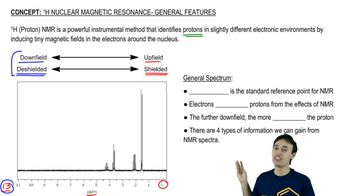
NMR spectroscopy is a powerful analytical technique used to determine the structure of organic compounds. It relies on the magnetic properties of certain nuclei, such as hydrogen-1 (1H), to provide information about the environment surrounding these nuclei. In the context of dinitrobenzenes, NMR can reveal differences in chemical shifts and splitting patterns based on the molecular symmetry and the electronic environment of the hydrogen atoms.
Recommended video:
Guided course
10:06
General NMR Features

Chemical Shifts

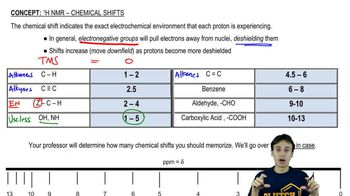
Chemical shifts in NMR spectroscopy refer to the resonance frequency of a nucleus relative to a standard reference frequency. They are influenced by the electronic environment surrounding the nucleus, which can vary significantly in different isomers of dinitrobenzene. For example, the presence of electron-withdrawing nitro groups can deshield hydrogen atoms, leading to distinct chemical shift values that help differentiate between 1,2-, 1,3-, and 1,4-dinitrobenzene.
Recommended video:
Guided course
11:44
1H NMR Chemical Shifts

Splitting Patterns (Multiplicity)

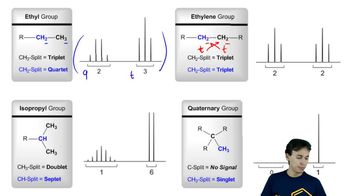
The splitting patterns observed in NMR spectra arise from the interactions between neighboring hydrogen atoms, known as spin-spin coupling. The number of peaks in a signal (multiplicity) provides insight into the number of adjacent hydrogen atoms. In the case of dinitrobenzenes, the different arrangements of nitro groups lead to unique splitting patterns for the hydrogen atoms, allowing for their differentiation through analysis of the NMR spectrum.
Recommended video:
Guided course
08:06
Common Splitting Patterns