Ch. 13 - Mass Spectrometry; Infrared Spectroscopy; UV/Vis Spectroscopy
Bruice - Organic Chemistry 8th Edition
Bruice8th EditionOrganic ChemistryISBN: 9780135213711Not the one you use?Change textbook
Chapter 14, Problem 3

What is the most likely m/z value for the base peak in the mass spectrum of 3-methylpentane?

Verified step by step guidance
1
Understand the problem: The base peak in a mass spectrum represents the most intense peak, which corresponds to the most stable and abundant ion formed during fragmentation. For 3-methylpentane, we need to determine the most likely fragment that would produce this peak.
Analyze the structure of 3-methylpentane: The molecular formula is C6H14. It is a branched alkane with a methyl group (-CH3) attached to the third carbon of a pentane chain.
Consider fragmentation patterns: In mass spectrometry, alkanes typically undergo cleavage at the weakest bonds, often forming carbocations. For 3-methylpentane, the cleavage of bonds adjacent to the branching point (the tertiary carbon) is likely to produce stable carbocations.
Identify the most stable carbocation: A tertiary carbocation (formed by the loss of a methyl group, CH3) is more stable than secondary or primary carbocations due to hyperconjugation and inductive effects. This tertiary carbocation will likely correspond to the base peak.
Determine the m/z value: The m/z value of the base peak corresponds to the mass of the most stable ion. Calculate the mass of the tertiary carbocation by subtracting the mass of the lost fragment (e.g., CH3, 15 amu) from the molecular ion (C6H14, 86 amu).

Verified video answer for a similar problem:

This video solution was recommended by our tutors as helpful for the problem above.
Video duration:
2m
Was this helpful?

Key Concepts

Here are the essential concepts you must grasp in order to answer the question correctly.

Mass Spectrometry

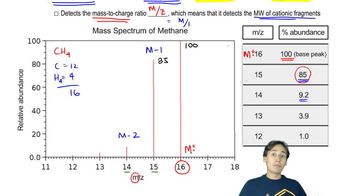
Mass spectrometry is an analytical technique used to measure the mass-to-charge ratio (m/z) of ions. It involves ionizing chemical species and sorting the ions based on their mass. The resulting mass spectrum provides information about the molecular weight and structure of the compound, which is essential for identifying the base peak.
Recommended video:
Guided course
01:25
How to Read a Mass Spectrum

Base Peak

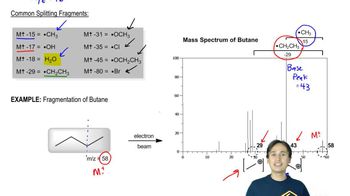
The base peak in a mass spectrum is the peak that represents the most abundant ion detected, and it is assigned a relative intensity of 100%. This peak is crucial for identifying the most stable fragment or ion produced during the ionization process, which can provide insights into the structure of the molecule being analyzed.
Recommended video:
Guided course
01:27
Clarification on the Base Peak

Fragmentation Patterns

Fragmentation patterns refer to the specific ways in which a molecule breaks apart during ionization in mass spectrometry. Understanding these patterns is vital for predicting the m/z values of the resulting ions. For 3-methylpentane, recognizing how the molecule can fragment helps in determining the most likely m/z value for the base peak, which typically corresponds to the most stable fragment.
Recommended video:
Guided course
08:06
Common Splitting Patterns