Ch. 13 - Mass Spectrometry; Infrared Spectroscopy; UV/Vis Spectroscopy
Bruice - Organic Chemistry 8th Edition
Bruice8th EditionOrganic ChemistryISBN: 9780135213711Not the one you use?Change textbook
Chapter 14, Problem 17f

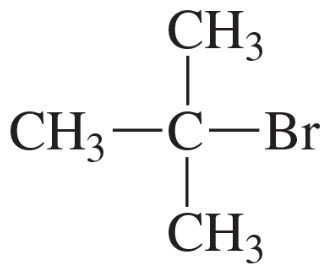
Using curved arrows, show the principal fragments you would expect to see in the mass spectrum of each of the following compounds:
f.

Verified step by step guidance
1
Identify the molecular structure of the compound provided in the problem. Analyze the functional groups, bonds, and overall connectivity to determine potential sites for fragmentation.
Recall that in mass spectrometry, fragmentation occurs due to the cleavage of bonds when the molecule is ionized. Use curved arrows to represent the movement of electrons during bond cleavage. Start by identifying the most likely bonds to break, such as weak bonds or bonds adjacent to functional groups.
For each fragmentation pathway, draw the resulting fragments. Ensure that one fragment retains the positive charge (cation) since mass spectrometry detects positively charged species. Use curved arrows to show how the electrons move to form these fragments.
Consider common fragmentation patterns, such as alpha cleavage (breaking a bond adjacent to a functional group), McLafferty rearrangement (if applicable), or loss of small neutral molecules like H2O, CO, or CH4. Apply these principles to the specific compound in question.
Label the principal fragments with their respective m/z (mass-to-charge) ratios based on their molecular weights. This will help in understanding which fragments are most likely to appear in the mass spectrum.

Verified video answer for a similar problem:

This video solution was recommended by our tutors as helpful for the problem above.
Video duration:
5m
Was this helpful?

Key Concepts

Here are the essential concepts you must grasp in order to answer the question correctly.

Mass Spectrometry

Mass spectrometry is an analytical technique used to measure the mass-to-charge ratio of ions. It provides information about the molecular weight and structure of compounds by fragmenting them into smaller pieces, which are then detected and analyzed. Understanding how compounds ionize and fragment is crucial for interpreting mass spectra.
Recommended video:
Guided course
01:25
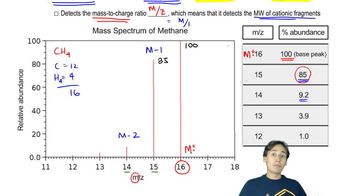
How to Read a Mass Spectrum

Curved Arrows in Mechanisms

Curved arrows are used in organic chemistry to represent the movement of electrons during chemical reactions. They indicate the flow of electron density, helping to visualize how bonds are formed or broken. This concept is essential for predicting the fragmentation patterns of molecules in mass spectrometry.
Recommended video:
Guided course
04:32
General Mechanism

Fragmentation Patterns

Fragmentation patterns refer to the specific ways in which a molecule breaks apart during ionization in mass spectrometry. These patterns are influenced by the structure of the molecule and can provide insights into its functional groups and connectivity. Recognizing common fragmentation pathways is key to interpreting mass spectra effectively.
Recommended video:
Guided course
08:06
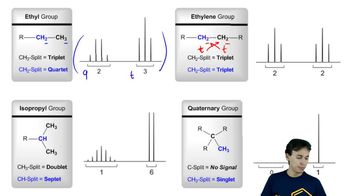
Common Splitting Patterns