Ch. 13 - Mass Spectrometry; Infrared Spectroscopy; UV/Vis Spectroscopy
Bruice - Organic Chemistry 8th Edition
Bruice8th EditionOrganic ChemistryISBN: 9780135213711Not the one you use?Change textbook
Chapter 14, Problem 32

Identify the compound that gives the mass spectrum and infrared spectrum shown here.
<IMAGE>

Verified step by step guidance
1
Step 1: Analyze the mass spectrum to determine the molecular ion peak (M+). This peak represents the molecular weight of the compound. Look for the highest m/z value with significant intensity, which corresponds to the molecular ion.
Step 2: Examine the fragmentation pattern in the mass spectrum. Identify any characteristic peaks that suggest the presence of specific functional groups or structural features. For example, a peak at m/z 15 might indicate a methyl group, while a peak at m/z 29 could suggest an ethyl group.
Step 3: Analyze the infrared (IR) spectrum to identify functional groups. Look for key absorption bands, such as a broad peak around 3200-3600 cm⁻¹ for an -OH group, a sharp peak near 1700 cm⁻¹ for a carbonyl group (C=O), or peaks in the 2800-3000 cm⁻¹ range for C-H stretching.
Step 4: Combine the information from the mass spectrum and IR spectrum. Use the molecular weight from the mass spectrum and the functional groups identified in the IR spectrum to propose a possible structure for the compound.
Step 5: Verify the proposed structure by ensuring it matches all observed spectral data. Check that the molecular weight, fragmentation pattern, and functional group absorptions are consistent with the suggested compound.

Verified video answer for a similar problem:

This video solution was recommended by our tutors as helpful for the problem above.
Video duration:
5m
Was this helpful?

Key Concepts

Here are the essential concepts you must grasp in order to answer the question correctly.

Mass Spectrometry

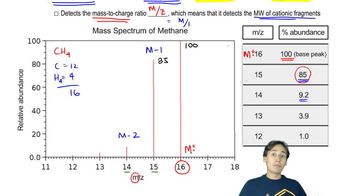
Mass spectrometry is an analytical technique used to measure the mass-to-charge ratio of ions. It helps in identifying the molecular weight and structure of compounds by fragmenting them into ions and analyzing the resulting mass spectrum. The peaks in the spectrum correspond to different ions, providing insights into the molecular composition and possible structures of the compound.
Recommended video:
Guided course
01:25
How to Read a Mass Spectrum

Infrared Spectroscopy

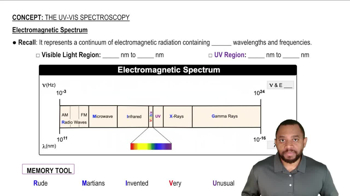
Infrared spectroscopy is a technique that measures the absorption of infrared light by a compound, which causes molecular vibrations. Each functional group in a molecule has a characteristic absorption pattern, allowing for the identification of specific bonds and functional groups present in the compound. The resulting infrared spectrum provides valuable information about the molecular structure and can help confirm the identity of the compound.
Recommended video:
2:56
The UV-Vis Spectroscopy Concept 1

Compound Identification

Compound identification involves using various analytical techniques, such as mass spectrometry and infrared spectroscopy, to determine the identity of a chemical substance. By comparing the obtained spectra with known reference data, chemists can deduce the molecular structure and functional groups present in the compound. This process is crucial in organic chemistry for confirming the identity of synthesized compounds or analyzing unknown samples.
Recommended video:
Guided course
01:40
Defining meso compounds.