Ch. 13 - Mass Spectrometry; Infrared Spectroscopy; UV/Vis Spectroscopy
Bruice - Organic Chemistry 8th Edition
Bruice8th EditionOrganic ChemistryISBN: 9780135213711Not the one you use?Change textbook
Chapter 14, Problem 72b

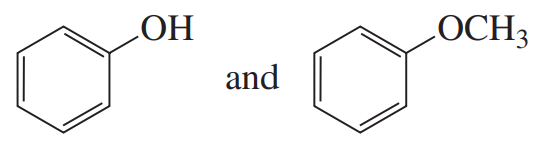
How can you use UV spectroscopy to distinguish between the compounds in each of the following pairs?
b. Chemical structures of phenol (OH) and anisole (OCH3) with the word "and" between them.

Verified step by step guidance
1
Step 1: Analyze the structures of compounds A and B. Compound A contains an amine group (-NH2) attached to a conjugated system, while compound B contains a protonated amine group (-NH3+) attached to the same conjugated system. The protonation state of the amine group affects the electronic environment of the conjugated system.
Step 2: Understand the principle of UV spectroscopy. UV spectroscopy measures the absorption of ultraviolet light by a molecule, which is influenced by the electronic transitions in conjugated systems. The presence of electron-donating or electron-withdrawing groups can shift the absorption maximum (λmax).
Step 3: Consider the effect of the amine group (-NH2) in compound A. The -NH2 group is an electron-donating group, which increases the electron density in the conjugated system. This typically results in a bathochromic shift (red shift) of the λmax, meaning the absorption occurs at a longer wavelength.
Step 4: Consider the effect of the protonated amine group (-NH3+) in compound B. The -NH3+ group is an electron-withdrawing group due to its positive charge. This decreases the electron density in the conjugated system, leading to a hypsochromic shift (blue shift) of the λmax, meaning the absorption occurs at a shorter wavelength.
Step 5: Use UV spectroscopy to distinguish between the two compounds. Measure the λmax for both compounds. Compound A will have a longer λmax due to the electron-donating -NH2 group, while compound B will have a shorter λmax due to the electron-withdrawing -NH3+ group. This difference in λmax can be used to identify and distinguish between the two compounds.

Verified video answer for a similar problem:

This video solution was recommended by our tutors as helpful for the problem above.
Video duration:
3m
Was this helpful?

Key Concepts

Here are the essential concepts you must grasp in order to answer the question correctly.

UV Spectroscopy Principles

UV spectroscopy is a technique that measures the absorption of ultraviolet light by molecules. When a molecule absorbs UV light, electrons are excited from a ground state to a higher energy state. The specific wavelengths of light absorbed can provide information about the electronic structure of the molecule, allowing for differentiation between compounds based on their functional groups and conjugation.
Recommended video:
2:56
The UV-Vis Spectroscopy Concept 1

Functional Groups and Their Effects

Different functional groups in organic compounds can significantly influence their UV absorption characteristics. For instance, amino groups (–NH2) and ammonium groups (–NH3+) have distinct electronic properties. The presence of a positive charge in ammonium can lead to different electronic transitions compared to neutral amino groups, affecting the UV spectrum and enabling differentiation between compounds A and B.
Recommended video:
Guided course
02:36
Identifying Functional Groups

Conjugation and Electron Delocalization

Conjugation refers to the overlap of p-orbitals across adjacent double bonds or lone pairs, allowing for electron delocalization. This delocalization lowers the energy gap between the ground and excited states, resulting in absorption of longer wavelengths of UV light. The degree of conjugation in compounds A and B will affect their UV spectra, making it a key factor in distinguishing between them.
Recommended video:
Guided course
05:29
Definition of Conjugation