Ch. 12 - Radicals
Bruice - Organic Chemistry 8th Edition
Bruice8th EditionOrganic ChemistryISBN: 9780135213711Not the one you use?Change textbook
Chapter 13, Problem 26e

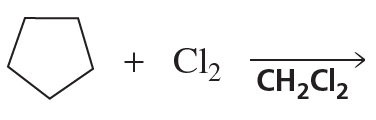
What are the product(s) of each of the following reactions? Disregard stereoisomers.
e. Cyclohexane reacts with chlorine gas to produce dichloroethane, illustrated with structural formulas.

Verified step by step guidance
1
Step 1: Identify the type of reaction. The reaction involves cyclohexane (C6H12) and chlorine (Cl2) in the presence of dichloromethane (CH2Cl2) as the solvent. This is a free radical halogenation reaction, typically initiated by light or heat.
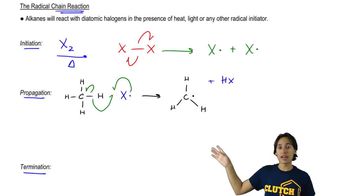
Step 2: Understand the mechanism. Free radical halogenation proceeds via three steps: initiation, propagation, and termination. In the initiation step, chlorine molecules are split into two chlorine radicals (Cl•) by light or heat.
Step 3: Analyze the propagation step. A chlorine radical abstracts a hydrogen atom from cyclohexane, forming a cyclohexyl radical and HCl. The cyclohexyl radical then reacts with another chlorine molecule to form chlorocyclohexane and regenerate a chlorine radical.
Step 4: Consider the product. Since stereoisomers are disregarded, the major product will be chlorocyclohexane (C6H11Cl), where one hydrogen atom on the cyclohexane ring is replaced by a chlorine atom.
Step 5: Note the regioselectivity. In this case, all hydrogens in cyclohexane are equivalent, so the chlorine can attach to any carbon atom in the ring, resulting in a single product without regioselectivity concerns.

Verified video answer for a similar problem:

This video solution was recommended by our tutors as helpful for the problem above.
Video duration:
2m
Was this helpful?

Key Concepts

Here are the essential concepts you must grasp in order to answer the question correctly.

Electrophilic Halogenation

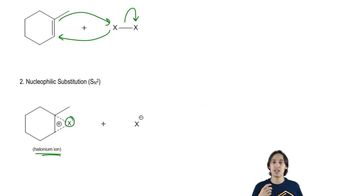
Electrophilic halogenation is a reaction where an alkene or alkane reacts with a halogen (like Cl2) to form a haloalkane. In this process, the halogen acts as an electrophile, attacking the electron-rich double bond or the C-H bonds in alkanes, leading to the substitution of hydrogen atoms with halogen atoms.
Recommended video:
Guided course
03:45
Halogenation Mechanism

Mechanism of Free Radical Halogenation

The mechanism of free radical halogenation involves three main steps: initiation, propagation, and termination. In the initiation step, Cl2 is dissociated into two chlorine radicals. During propagation, these radicals react with cyclohexane to form dichlorocyclohexane and additional radicals, which can continue the reaction. Termination occurs when two radicals combine to form a stable product.
Recommended video:
Guided course
12:11
Radical Chain Reaction Mechanism.

Dichlorocyclohexane Isomers

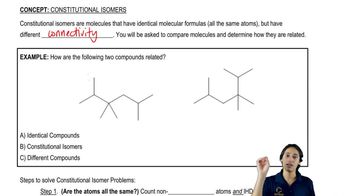
Dichlorocyclohexane can exist in multiple isomeric forms due to the different positions where chlorine atoms can be substituted on the cyclohexane ring. However, the question specifies to disregard stereoisomers, focusing only on the structural isomers that result from the substitution of hydrogen atoms with chlorine, leading to products like 1,2-dichlorocyclohexane and 1,4-dichlorocyclohexane.
Recommended video:
Guided course
01:10
What is a constitutional isomer?