Ch. 12 - Radicals
Bruice - Organic Chemistry 8th Edition
Bruice8th EditionOrganic ChemistryISBN: 9780135213711Not the one you use?Change textbook
Chapter 13, Problem 39a

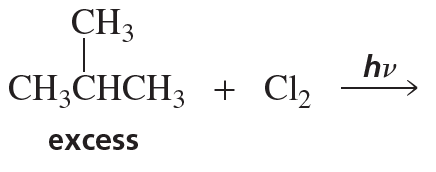
What alkyl halide will be obtained in greatest yield? Ignore stereoisomers.
a. Chemical reaction showing alkane with chlorine under light, indicating excess reactant for halogenation process.

Verified step by step guidance
1
Analyze the reaction conditions provided in the problem (e.g., reagents, solvents, and temperature) to determine the type of reaction mechanism involved (e.g., SN1, SN2, E1, or E2). This will help predict the major product.
Identify the starting material and determine the site of substitution or elimination based on the structure of the molecule and the reaction mechanism.
Consider the stability of the carbocation intermediate if the reaction proceeds via an SN1 or E1 mechanism. More stable carbocations (e.g., tertiary > secondary > primary) will lead to the major product.
For SN2 reactions, consider steric hindrance at the electrophilic carbon. Less hindered primary or secondary carbons are more likely to undergo substitution in SN2 mechanisms.
Determine the structure of the alkyl halide product based on the reaction mechanism and the regioselectivity or stereoselectivity of the reaction. Ignore stereoisomers as instructed in the problem.

Verified video answer for a similar problem:

This video solution was recommended by our tutors as helpful for the problem above.
Video duration:
7m
Was this helpful?

Key Concepts

Here are the essential concepts you must grasp in order to answer the question correctly.

Alkyl Halides

Alkyl halides are organic compounds derived from alkanes by replacing one or more hydrogen atoms with halogen atoms (F, Cl, Br, I). They are classified based on the number of carbon atoms attached to the carbon bearing the halogen: primary, secondary, or tertiary. The structure of the alkyl halide significantly influences its reactivity and the types of reactions it can undergo.
Recommended video:
Guided course
01:52
How to name alkyl halides

Nucleophilic Substitution Reactions

Nucleophilic substitution reactions involve the replacement of a leaving group (like a halogen) by a nucleophile. The mechanism can be either SN1 or SN2, depending on the structure of the alkyl halide and the conditions of the reaction. SN2 reactions are favored by primary alkyl halides due to steric accessibility, while SN1 reactions are more common with tertiary alkyl halides due to stability of the carbocation intermediate.
Recommended video:
Guided course
01:47
Nucleophiles and Electrophiles can react in Substitution Reactions.

Reaction Yield

Reaction yield refers to the amount of product obtained from a chemical reaction compared to the theoretical maximum amount possible. Factors influencing yield include the structure of the starting materials, reaction conditions, and the presence of competing reactions. In the context of alkyl halides, the stability of the resulting product and the efficiency of the substitution mechanism play crucial roles in determining which alkyl halide will be produced in the greatest yield.
Recommended video:
Guided course
04:37
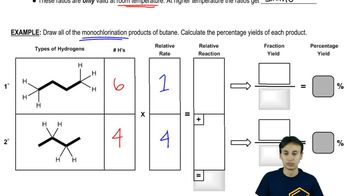
Draw all of the monochlorination products and calculate percentage yields.