At 600 °C, the ratio of the relative rates of formation of a tertiary, a secondary, and a primary radical by a chlorine radical is 2.6 : 2.1 : 1. Explain the change in the degree of regioselectivity compared to what was found in Problem 44.
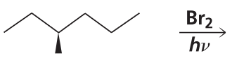
Draw the products of the following reactions, including all stereoisomers:
d. 
Verified step by step guidance
Verified video answer for a similar problem:
Key Concepts
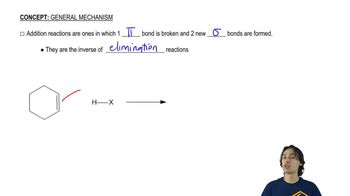
Electrophilic Addition Reactions
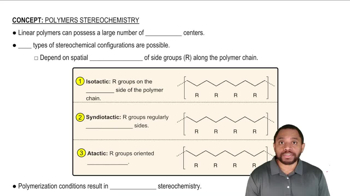
Stereochemistry and Stereoisomers
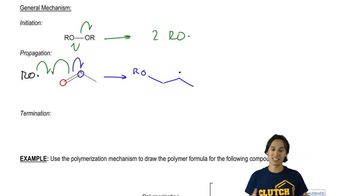
Radical Mechanism
Draw the products of the following reactions, including all stereoisomers:
c.
Draw the products of the following reactions, including all stereoisomers:
f.
Calculate the ∆H° value for the following reaction:
Draw the products of the following reactions, including all stereoisomers:
e.
A chemist wanted to determine experimentally the relative ease of removing a hydrogen atom from a tertiary, a secondary, and a primary carbon by a chlorine radical. He allowed 2-methylbutane to undergo chlorination at 300 °C and obtained as products 36% 1-chloro-2-methylbutane, 18% 2-chloro-2-methylbutane, 28% 2-chloro-3-methylbutane, and 18% 1-chloro-3-methylbutane. What values did he obtain for the relative ease of removing a hydrogen atom from tertiary, secondary, and primary hydrogen carbons by a chlorine radical under the conditions of his experiment?