Ch. 12 - Radicals
Bruice - Organic Chemistry 8th Edition
Bruice8th EditionOrganic ChemistryISBN: 9780135213711Not the one you use?Change textbook
Chapter 13, Problem 20a

How many stereoisomers are formed from the reaction of cyclohexene with NBS?

Verified step by step guidance
1
Step 1: Understand the reaction mechanism. Cyclohexene reacts with NBS (N-Bromosuccinimide) in the presence of light or a radical initiator to form an allylic bromination product. This reaction proceeds via a radical mechanism where the bromine atom is added to the allylic position of cyclohexene.
Step 2: Identify the allylic positions in cyclohexene. The allylic positions are the carbon atoms adjacent to the double bond. In cyclohexene, there are two equivalent allylic positions on either side of the double bond.
Step 3: Consider the stereochemistry of the product. The bromine atom can be added to either of the two allylic positions, and the resulting product can have different spatial arrangements (stereoisomers) due to the presence of chiral centers.
Step 4: Analyze the symmetry of cyclohexene. Cyclohexene is a symmetrical molecule, so the addition of bromine to either allylic position will produce equivalent products. However, the stereochemistry of the product depends on whether the bromine is added above or below the plane of the molecule, leading to potential enantiomers.
Step 5: Determine the number of stereoisomers. Since the reaction can produce enantiomers (non-superimposable mirror images), the total number of stereoisomers formed will depend on the number of chiral centers created in the product. Count the possible configurations to determine the total number of stereoisomers.

Verified video answer for a similar problem:

This video solution was recommended by our tutors as helpful for the problem above.
Video duration:
1m
Was this helpful?

Key Concepts

Here are the essential concepts you must grasp in order to answer the question correctly.

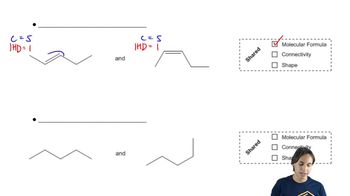
Stereoisomerism

Stereoisomerism refers to the phenomenon where compounds have the same molecular formula and connectivity of atoms but differ in the spatial arrangement of their atoms. This can lead to different physical and chemical properties. In organic chemistry, stereoisomers include enantiomers and diastereomers, which are crucial for understanding reactions that produce multiple isomers.
Recommended video:
Guided course
01:58
Determining when molecules are stereoisomers.

Cyclohexene

Cyclohexene is a six-membered carbon ring with one double bond, making it an alkene. Its structure allows for various reactions, including electrophilic additions. Understanding the reactivity of cyclohexene is essential for predicting the products formed when it reacts with reagents like N-bromosuccinimide (NBS).
Recommended video:
Guided course
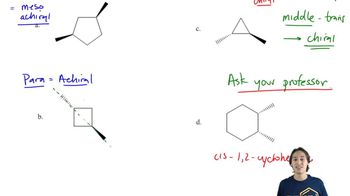
01:20
Is the following disubstituted cyclohexane chiral?

N-bromosuccinimide (NBS)

N-bromosuccinimide (NBS) is a reagent commonly used in organic chemistry for bromination reactions. It selectively adds bromine across double bonds, leading to the formation of brominated products. When cyclohexene reacts with NBS, it can generate multiple stereoisomers due to the formation of a bromonium ion intermediate, which can lead to different stereochemical outcomes.
Recommended video:
3:06
Synthesis of Amino Acids: N-Phthalimidomalonic Ester Synthesis Concept 1