
When 2-methylpropane is monochlorinated in the presence of light at room temperature, 36% of the product is 2-chloro-2-methylpropane and 64% is 1-chloro-2-methylpropane. From these data, calculate how much easier it is to remove a hydrogen atom from a tertiary carbon than from a primary carbon under these conditions.
Ch. 12 - Radicals
Chapter 13, Problem 37a
How many monochlorination products can be obtained from the radical chlorination of methylcyclohexane? Disregard stereoisomers.
Verified step by step guidance1
Identify the structure of methylcyclohexane. It consists of a cyclohexane ring with a single methyl group attached to one of the carbons.
Determine the types of hydrogen atoms present in methylcyclohexane. There are primary hydrogens (on the methyl group), secondary hydrogens (on the carbons of the cyclohexane ring), and tertiary hydrogens (if applicable, but not in this case).
Analyze the symmetry of the molecule. Methylcyclohexane has a plane of symmetry, which means equivalent hydrogens will produce identical monochlorination products.
Count the unique positions where a chlorine atom can replace a hydrogen atom. Focus on the unique carbon atoms (based on symmetry) and their attached hydrogens. For example, the methyl group hydrogens are equivalent, and the secondary hydrogens on the cyclohexane ring may differ depending on their position relative to the methyl group.
Sum up the number of unique monochlorination products by considering all unique substitution sites and disregarding stereoisomers, as specified in the problem.

Verified video answer for a similar problem:
This video solution was recommended by our tutors as helpful for the problem above.
Video duration:
2mWas this helpful?
Key Concepts
Here are the essential concepts you must grasp in order to answer the question correctly.
Radical Chlorination
Radical chlorination is a reaction where chlorine radicals replace hydrogen atoms in an organic molecule, typically alkanes. This process involves the formation of reactive chlorine radicals through the homolytic cleavage of Cl2, leading to a series of chain reactions that can yield multiple products. Understanding this mechanism is crucial for predicting the number of products formed during the reaction.
Recommended video:
Guided course
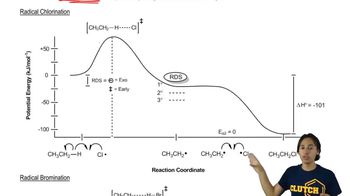
Using the Hammond Postulate to describe radical chlorination.
Monochlorination Products
Monochlorination products refer to the compounds formed when only one hydrogen atom in a molecule is replaced by a chlorine atom. In the case of methylcyclohexane, identifying the unique positions where chlorination can occur is essential to determine the total number of distinct monochlorination products, excluding stereoisomers.
Recommended video:
Guided course
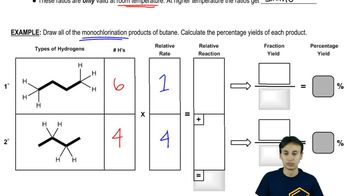
Draw all of the monochlorination products and calculate percentage yields.
Methylcyclohexane Structure
Methylcyclohexane is a cycloalkane with a methyl group attached to a cyclohexane ring. Its structure influences the reactivity and the positions available for chlorination. Recognizing the symmetry and the different hydrogen atoms available for substitution helps in calculating the potential products from the radical chlorination process.
Recommended video:
Guided course
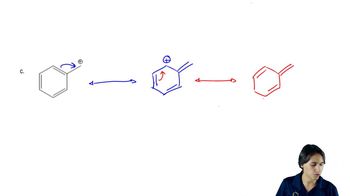
Drawing Resonance Structures
Related Practice
Textbook Question
Textbook Question
Propose a mechanism to account for the products formed in the following reaction:
2
views
Textbook Question
The deuterium kinetic isotope effect for the halogenation of an alkane is defined in the following equation, where X・ = Cl・ or Br・
Predict whether chlorination or bromination would have a greater deuterium kinetic isotope effect.
6
views
Textbook Question
How many monochlorination products would be obtained if all stereoisomers are included?
1
views
Textbook Question
What five-carbon alkene forms the same product whether it reacts with HBr in the presence of a peroxide or with HBr in the absence of a peroxide?
5
views
Textbook Question
Which product would be obtained in greatest yield? Explain.
