Ch. 11 - Organometallic Compounds
Bruice - Organic Chemistry 8th Edition
Bruice8th EditionOrganic ChemistryISBN: 9780135213711Not the one you use?Change textbook
Chapter 12, Problem 15

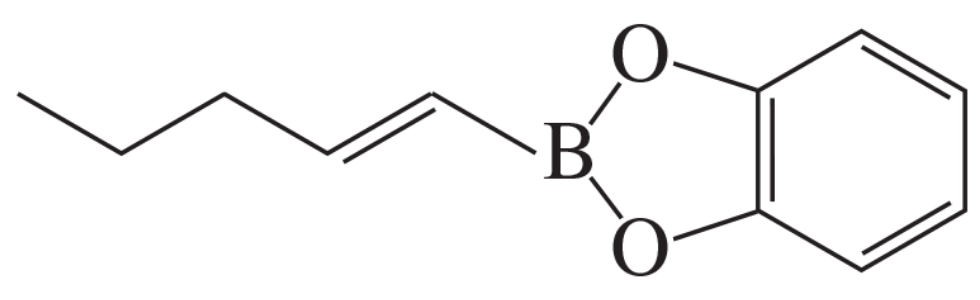
What hydrocarbon would you use to prepare the organoboron compound in Problem 14?

Verified step by step guidance
1
Analyze the structure of the organoboron compound provided in the image. The compound contains a boron atom bonded to two oxygen atoms in a cyclic structure (a catechol group) and a hydrocarbon chain attached to the boron atom.
Identify the hydrocarbon chain attached to the boron atom. In this case, the chain is a straight alkyl chain with five carbon atoms and a double bond between the second and third carbons, indicating it is 1-pentene.
Recall the hydroboration reaction mechanism, which involves the addition of borane (BH3) or a boron-containing reagent to an alkene. The boron atom adds to the less substituted carbon of the double bond, following anti-Markovnikov regioselectivity.
Determine the hydrocarbon needed for the reaction. Since the organoboron compound has a pentyl group with a double bond, the starting hydrocarbon should be 1-pentene, which will react with a boron reagent such as catecholborane.
Conclude that the hydrocarbon required to prepare the organoboron compound is 1-pentene, which undergoes hydroboration with catecholborane to yield the desired product.

Verified video answer for a similar problem:

This video solution was recommended by our tutors as helpful for the problem above.
Video duration:
2m
Was this helpful?

Key Concepts

Here are the essential concepts you must grasp in order to answer the question correctly.

Hydrocarbons

Hydrocarbons are organic compounds consisting entirely of hydrogen and carbon atoms. They serve as the fundamental building blocks for many organic reactions, including those involving organoboron compounds. Understanding the structure and reactivity of different types of hydrocarbons, such as alkanes, alkenes, and alkynes, is crucial for selecting the appropriate substrate for synthesis.
Recommended video:
Guided course
04:52
Aromaticity of Hydrocarbons

Organoboron Compounds

Organoboron compounds are organic molecules that contain boron atoms bonded to carbon. They are important intermediates in organic synthesis, particularly in cross-coupling reactions like the Suzuki reaction. Knowledge of how to prepare and utilize these compounds is essential for solving problems related to organic synthesis and reactivity.
Recommended video:
Guided course
01:40
Defining meso compounds.

Synthesis Strategies

Synthesis strategies in organic chemistry involve the methods and pathways used to create specific compounds from simpler starting materials. This includes understanding functional group transformations, reactivity patterns, and the selection of appropriate reagents. A solid grasp of these strategies is necessary to determine which hydrocarbon can effectively yield the desired organoboron compound.
Recommended video:
1:16
Synthesis of Amino Acids: Strecker Synthesis Example 1