Ch. 11 - Organometallic Compounds
Bruice - Organic Chemistry 8th Edition
Bruice8th EditionOrganic ChemistryISBN: 9780135213711Not the one you use?Change textbook
Chapter 12, Problem 67d

The Reformatsky reaction is an addition reaction in which an organozinc reagent is used instead of a Grignard reagent to add to the carbonyl group of an aldehyde or a ketone. Because the organozinc reagent is less reactive than a Grignard reagent, a nucleophilic addition to the ester group does not occur.
The organozinc reagent is prepared by treating an α-bromo ester with zinc.

Describe how each of the following compounds can be prepared, using a Reformatsky reaction:
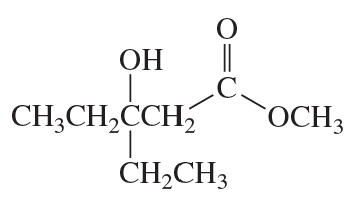
d. Structural formula of an organic compound featuring an alcohol and an ester functional group.

Verified step by step guidance
1
Step 1: Identify the target compound structure. The compound shown is a β-hydroxy ester, which is a typical product of the Reformatsky reaction. The hydroxyl group is attached to the β-carbon relative to the ester group.
Step 2: Select the starting materials. For the Reformatsky reaction, you need an α-bromo ester and a carbonyl compound. In this case, the α-bromo ester should correspond to the ester group in the product, and the carbonyl compound should correspond to the β-hydroxy group in the product.
Step 3: Prepare the organozinc reagent. Treat the α-bromo ester (e.g., methyl bromoacetate) with zinc metal to form the organozinc reagent. This reagent is less reactive than a Grignard reagent and will selectively react with the carbonyl compound.
Step 4: Perform the nucleophilic addition. React the organozinc reagent with the appropriate aldehyde (e.g., isobutyraldehyde) under suitable conditions. The nucleophilic addition occurs at the carbonyl group, forming a β-hydroxy ester intermediate.
Step 5: Isolate and purify the product. After the reaction is complete, the β-hydroxy ester can be isolated and purified using standard organic chemistry techniques such as extraction, distillation, or recrystallization.

Verified video answer for a similar problem:

This video solution was recommended by our tutors as helpful for the problem above.
Video duration:
4m
Was this helpful?

Key Concepts

Here are the essential concepts you must grasp in order to answer the question correctly.

Reformatsky Reaction

The Reformatsky reaction is a chemical reaction that involves the addition of an organozinc reagent to a carbonyl compound, typically an aldehyde or ketone. This reaction is notable for using organozinc reagents, which are less reactive than Grignard reagents, allowing for selective reactions without unwanted side reactions, such as nucleophilic addition to esters.
Recommended video:
Guided course
05:09
Heck Reaction

Organozinc Reagents

Organozinc reagents are organometallic compounds that contain a carbon-zinc bond. They are prepared by treating alkyl or aryl halides with zinc metal. These reagents are less reactive than Grignard reagents, making them useful in reactions where controlled reactivity is desired, such as in the Reformatsky reaction, where they selectively add to carbonyl groups.
Recommended video:

Nucleophilic Addition

Nucleophilic addition is a fundamental reaction mechanism in organic chemistry where a nucleophile attacks an electrophilic carbon atom, typically in a carbonyl group. In the context of the Reformatsky reaction, the organozinc reagent acts as the nucleophile, adding to the carbonyl carbon of an aldehyde or ketone, leading to the formation of an alcohol after subsequent reactions.
Recommended video:
Guided course
08:27
Nucleophilic Addition